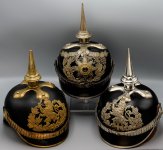
Hessian Officer

USN

Well-known member
Good evening gentlemen,

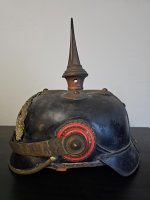
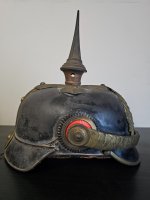
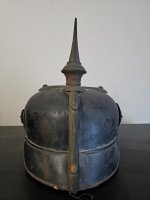
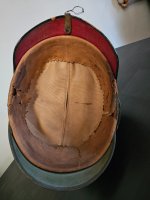
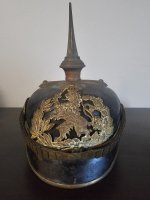
Ive recently come across this honest looking hessian officer and for the price I couldnt let it go. Its solid from top to bottom having what I understand as either an early or private purchase tall fluted spike, flat chinscales, and all the appropriate fittings which are all tight to the helmet and i like that there is a small bit of old picture wire underneath the rear spine which has the same amount of corrosion as the rest of the helmet so I'm certain it was placed there by the veteran or his family and hung on his wall after the war. The liner is in pretty good shape minus the tears in the leather on the sides, the silk liner is in great shape and still has what feels like metal supports in them to keep the silk from sagging down. As always thoughts and opinions are welcome.

Many Thanks,
USN
20250829_173307.jpg

20250829_173338.jpg

20250829_173348.jpg

20250829_173355.jpg

20250829_173406.jpg
 
Very nice and restorable, USN. Are metal fittings gold or oxidized silver (unscrew the spike to be sure)? The lion seems to be matt silvered.
The only puzzling detail is the chinscales. All Hessian officer helmets sported curved chinscales, except at JR115.
 
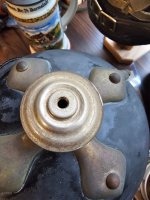
All of the fittings are brass and the spike would unscrew but its pretty tight and I dont wanna risk damaging the leather
 
Actually I may have been mistaken, i was able to get the spike off, either the nut in the bass is messed up or the spike screw itself is bent because it did NOT want to come off. Luckily nothing was damaged but underneath the spike does appear to be silver.
 
Actually I may have been mistaken, i was able to get the spike off, either the nut in the bass is messed up or the spike screw itself is bent because it did NOT want to come off. Luckily nothing was damaged but underneath the spike does appear to be silver.
This was my impression. The alloy they used ("Nickel silver", aka maillechort) actually contains no silver but nickel, copper, and zinc. When heavily oxidized it can adopt these greyish, greenish hues. You should have here a Hessian Dragoner helmet. We remain stuck with chinscales...
 
Is it possible that the extra fittings were removed or lost years ago and the rest of the fittings aged evenly without them?
 
Is it possible that the extra fittings were removed or lost years ago and the rest of the fittings aged evenly without them?
What do you mean by extra fittings? Curved chinscales being lost and replaced? Yes of course, but this should have been done a very long time ago since the patina is even. What you could do is check how chinscales are affixed inside the shell (mind the fragile, torn liner). Are those carefully attached, with washers?
 
What do you mean by extra fittings? Curved chinscales being lost and replaced? Yes of course, but this should have been done a very long time ago since the patina is even. What you could do is check how chinscales are affixed inside the shell (mind the fragile, torn liner). Are those carefully attached, with washers?
I guess i was entertaining the idea of it being a JR 115 helmet since it would seem that those fittings would be more likely to come off than a whole set of chinscales. But on the chance that this is dragoons its possible that his original chinscales were damaged and he was unable to get curved replacements.
 
I guess i was entertaining the idea of it being a JR 115 helmet since it would seem that those fittings would be more likely to come off than a whole set of chinscales. But on the chance that this is dragoons its possible that his original chinscales were damaged and he was unable to get curved replacements.
A former JR115 is most unlikely. The lion plate was different (see above), the spike base had stars, and you would see prints from the scroll in the shell.
If all fittings are silver it can only be a Dragoner. DR23 or DR24. Same helmet.
 
A former JR115 is most unlikely. The lion plate was different (see above), the spike base had stars, and you would see prints from the scroll in the shell.
If all fittings are silver it can only be a Dragoner. DR23 or DR24. Same helmet.
It does however seem to match the pre 1897 style of fittings which was worn by JR115, and reading through the kaisers bunker JR115 had attempted to chemically whiten their fittings which evidently did not work and heavily tarnished them which could also explain why these fittings are in the shape theyre in. DR. 24 or 23 would be interesting as I do have a DR. 24 enlisted man's helmet but I just can't explain why the chinscales would be different, especially since officers were held to a high standard.
 
Also if the scroll had disappeared 100 years ago the shell would have tarnished evenly without it, you do however have a point with the spike base stars. Unless this is potentially a OYV helmet.
 
Unfortunately just about any explanation for the strange configuration is completely theoretical, all the parts of the helmet to include the chinscale mounts are absolutely tight to the helmet
 
Has anyone had any luck with using a tap and dye set to repair damaged threads on helmets before?
 
"tap and dye set to repair damaged threads" ?
What do you mean?
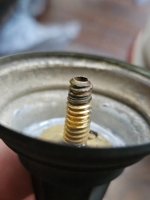
A tap and die set is a tool set that you use to cut a new set of threads into material or to clean up damaged/ worn threads on hardware, you use it on anything from nuts and bolts to threaded inserts, my main concern would be the thread pattern of 100+ year old hardware vs. Newer hardware if they'd even be compatible, looking at the threads on the spike of this helmet they have definitely been damaged over the years and I was hoping to clean them up a little.
 
In my experience, Imperial German threads are different than modern threads. We run into this problem with spikes, wappen, star studs and nutted spike bade studs. I am an engineer and have access to thread gages and optical measuring devices, but I have never found a modern size that matched the old threads. They were metric, however there were no standards as we internationally have today. I recall someone on the forum stating that “bicycle” threads are similar to the old German ones, but I have not researched them. On your example, it appears someone possibly installed a spike stud with a similar diameter, but with different pitch (number of threads per mm length). In this case, it would start and install a few turns before binding on the improper thread clearance causing damage to the threads. Looking at your photo, I assume you are unable to fully seat the spike on the base? If that’s the case, you might try putting oil on both the spike stud and the base nut, and repeatedly and carefully tighten and loosen the stud. You may gain enough to seat the spike. They make a thread file that is square with different pitches on each face. You might find a pitch that is close to that on your spike and dress them up.

Ron
 
  • Like
Reactions: USN
You are correct the spike does not seat but that is also because from the looks of it the shank of the spike mount is slightly bent so thats no help either.
 
Back
Top