Looking for information...

Joos

Member
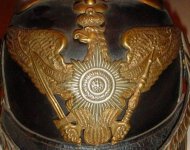
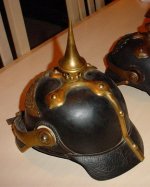
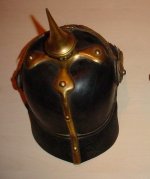
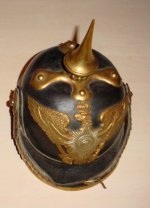
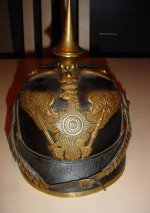
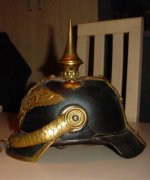
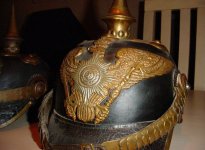
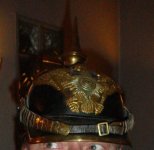
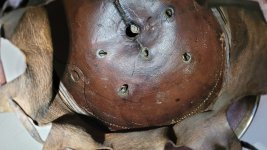
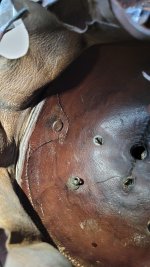
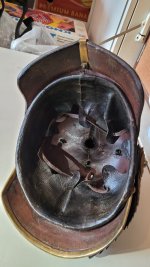
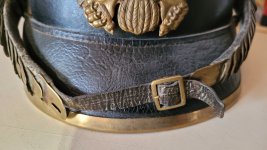
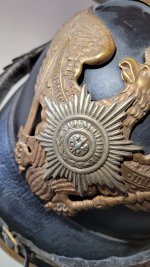
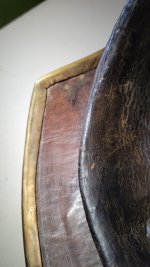
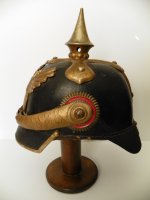
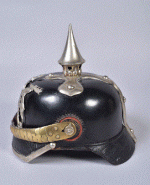
Can someone provide more information about this Prussian Pickelhaube?

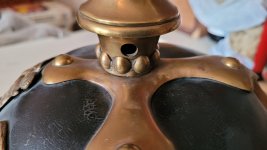
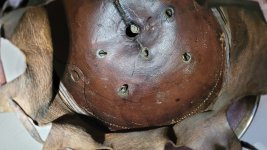
It is a helmet that was found in the 1990s by workers (bricklayers) who were renovating an old house in Brussels (Belgium). They handled the helmet rather roughly, eventually throwing it into a waste container. Due to this “mistreatment,” the spike of the helmet broke off. The person who retrieved the helmet from the container was unable to recover the original spike.

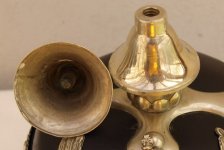
Afterwards, the helmet was cleaned and restored where necessary. A different spike was fitted, but it is likely not the correct one. That is why I am making this post: does anyone know more about this type of helmet, and possibly which spike it should originally have had?

Thank you in advance.
 

Attachments

  • 20260331_183551.jpg
    20260331_183551.jpg
    64.3 KB · Views: 31
  • Screenshot_20260331_183321_Photos.jpg
    Screenshot_20260331_183321_Photos.jpg
    75.8 KB · Views: 27
  • Screenshot_20260331_183318_Photos.jpg
    Screenshot_20260331_183318_Photos.jpg
    52.5 KB · Views: 28
  • Screenshot_20260331_183314_Photos.jpg
    Screenshot_20260331_183314_Photos.jpg
    50.5 KB · Views: 30
  • Screenshot_20260331_183309_Photos.jpg
    Screenshot_20260331_183309_Photos.jpg
    142.7 KB · Views: 31
  • Screenshot_20260331_183304_Photos.jpg
    Screenshot_20260331_183304_Photos.jpg
    63.4 KB · Views: 31
  • Screenshot_20260331_183257_Photos.jpg
    Screenshot_20260331_183257_Photos.jpg
    171.3 KB · Views: 32
  • 20260331_183520.jpg
    20260331_183520.jpg
    39.8 KB · Views: 32
  • 20260401_101746.jpg
    20260401_101746.jpg
    1.6 MB · Views: 12
  • 20260401_101752.jpg
    20260401_101752.jpg
    1.7 MB · Views: 12
  • 20260401_101804.jpg
    20260401_101804.jpg
    1.5 MB · Views: 10
  • 20260401_101816.jpg
    20260401_101816.jpg
    1.4 MB · Views: 10
  • 20260401_101832.jpg
    20260401_101832.jpg
    1.2 MB · Views: 13
Hello,
To think it might have ended up in the trash...
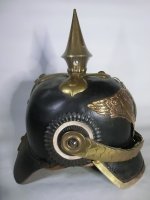
This is a spiked helmet from the Prussian Foot Guard (not the Guard Grenadiers). With its new eagle featuring an integrated Vaterland band, this helmet complies with the AKO of September 4, 1870.
It’s perfect, except for:
---The cockade, which is an M67 that’s too small.
---The spire, which is too long because it’s an officer’s spire from around 1900.

Question: Is there a regimental mark under the neck guard?
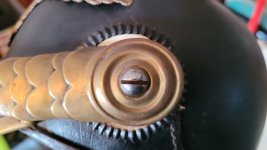
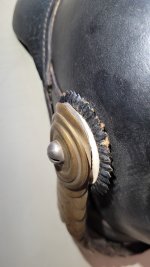
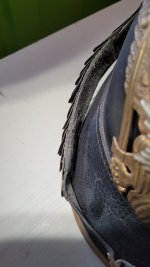
M60 GzF 1B FIM 700€ en 2021.JPG The specific details are important, because if the chin strap is original and features domed scales, this could be a later-model helmet belonging to the Prussian Guard Dragoons. Indeed, the Dragoons continued to use this helmet—with its angular visor, visible rivets on the rear spine, and, most notably, domed chin strap scales—until 1894,
 
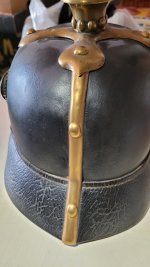
If you look closely, the rosettes on the chin scales are curved to match the convex cavalry chin scales. So in my opinion a Guard Dragoon helmet pre 1890 with bolt on scales and dragoon rear spine. This type of spine has 2 domed rivets holding it to the shell which is shown in these photos.
 
If you look closely, the rosettes on the chin scales are curved to match the convex cavalry chin scales. So in my opinion a Guard Dragoon helmet pre 1890 with bolt on scales and dragoon rear spine. This type of spine has 2 domed rivets holding it to the shell which is shown in these photos.
I agree with that, insofar as the M60 helmet was identical for the Dragoons and the (Guards) Infantry—with the exception of the chin strap—until 1867. At that point, the Dragoon helmet remained unchanged until 1894, when it was fitted with the M91 infantry-style side posts with lugs, along with detachable chin straps. Another clue is the small size of the Prussian cockade, which is a 1867 model.

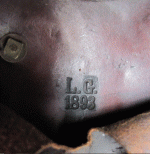
However, I would add that this helmet could also belong to a mounted Landgendarme; in that case, it would be marked “L.G.” with the date, most commonly between the eagle’s attachments.

LG 1893 Landgendarme.GIF
 
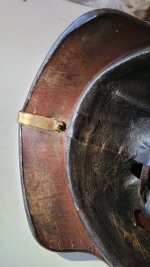
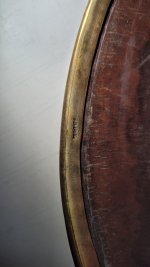
20260401_101847.jpgNo markings on the helmet, except for a small marking on the copper rim of the front visor. However, it is quite unclear, and I cannot read it.
Additional photos have been added to the post, but the limit is 13. Therefore, a few more photos have been included in the replies.
 
Extra photo's
 

Attachments

  • 20260401_102246.jpg
    20260401_102246.jpg
    1.3 MB · Views: 6
  • 20260401_102044.jpg
    20260401_102044.jpg
    1.3 MB · Views: 6
  • 20260401_102034.jpg
    20260401_102034.jpg
    1.4 MB · Views: 6
  • 20260401_102022.jpg
    20260401_102022.jpg
    1.2 MB · Views: 5
  • 20260401_102009.jpg
    20260401_102009.jpg
    1.5 MB · Views: 4
  • 20260401_102002.jpg
    20260401_102002.jpg
    1.3 MB · Views: 5
  • 20260401_101902.jpg
    20260401_101902.jpg
    1.2 MB · Views: 5
Furthermore, the helmet was found as shown in the photo, aside from the spike of course.
He is also not certain about the cockades; these may have been replaced with others. However, the chinstrap was originally included.
 
Your helmet is indeed a Dragon M1867 model.
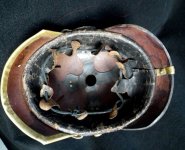
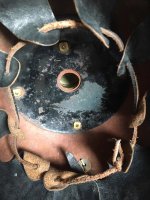
After 1894, it was fitted with side plates, which is not the case here. The spike is no longer the heavy M60 spike; it has been lightened. However, it still has the cap covering the two vents, which would disappear in 1895, just as the vent would be changed to five ventilation holes at that same time.

However, your cockade does indeed seem too small to me, as it is largely obscured by the brass rosette.
Bad 20-21-22 Trup PHcom.JPG
Below is a Dragon M95 headset :

Wurt DR troupe.GIF .
And normally, your chimney should have a prominent dome if it’s a Dragon. A spire and an infantry funnel don’t really go together, in theory. In the case of a Dragon spire, the screw is deeper.
Pte Dragon idem M60 Infanterie.jpg
The mark on the visor reinforcement is the manufacturer's mark for the brass fittings.

This helmet is therefore indeed a Prussian Dragoon helmet, M67, in service until the new model of 1895.
 
Last edited:
Your helmet is indeed a Dragon M1867 model.
After 1894, it was fitted with side plates, which is not the case here. The spike is no longer the heavy M60 spike; it has been lightened. However, it still has the cap covering the two vents, which would disappear in 1895, just as the vent would be changed to five ventilation holes at that same time.

However, your cockade does indeed seem too small to me, as it is largely obscured by the brass rosette.
View attachment 74967
Below is a Dragon M95 headset :

View attachment 74970 .
And normally, your chimney should have a prominent dome if it’s a Dragon. A spire and an infantry funnel don’t really go together, in theory. In the case of a Dragon spire, the screw is deeper.
View attachment 74968
The mark on the visor reinforcement is the manufacturer's mark for the brass fittings.

This helmet is therefore indeed a Prussian Dragoon helmet, M67, in service until the new model of 1895.
Thx!
 
Another small update about the helmet. It was apparently found in the mid-1980s.
It concerned a house where a German officer lived (presumably with his wife), but who moved to South America at an unknown time. Most likely, they passed away there in the 1980s, after which the heirs (children and/or grandchildren?) decided to empty the house and have it renovated.
At that time, the construction company was instructed to throw everything into a container, which they did. In the attic, besides the helmet, there were many other objects from the World War I period, such as newspapers, officers’ reports, books, some weapon parts, the helmet, and probably much more, though that information has been lost over time. Apart from the helmet, everything ended up in a landfill.
The person who managed to save the helmet was one of the bricklayers. He heard the story of the former residents from his foreman at the time.
No further information can be retrieved, as the bricklayers are no longer known or have already passed away. The foreman from that time passed away many years ago.
The address in question can no longer be traced either.
 
Your helmet is indeed a Dragon M1867 model.
After 1894, it was fitted with side plates, which is not the case here. The spike is no longer the heavy M60 spike; it has been lightened. However, it still has the cap covering the two vents, which would disappear in 1895, just as the vent would be changed to five ventilation holes at that same time.

However, your cockade does indeed seem too small to me, as it is largely obscured by the brass rosette.
View attachment 74967
Below is a Dragon M95 headset :

View attachment 74970 .
And normally, your chimney should have a prominent dome if it’s a Dragon. A spire and an infantry funnel don’t really go together, in theory. In the case of a Dragon spire, the screw is deeper.
View attachment 74968
The mark on the visor reinforcement is the manufacturer's mark for the brass fittings.

This helmet is therefore indeed a Prussian Dragoon helmet, M67, in service until the new model of 1895.
A Guard Dragoon helmet?
 
A Guard Dragoon helmet?

yes, that’s what I had said in my first speech. Garde-Adler mit Garde-Stern.
Ok, sorry that I wasn’t completely following. Because of the specific terminology in English, I hadn’t fully understood at first, but now I do.
Concretely, it seems that the cockades should be of a larger model, and the pin—which was also replaced—is of a smaller type. The pin that is currently on it, was that from an officer?

The helmet isn’t at my home, but I’ll check the pin as soon as possible. I’ll disassemble it and send a photo of the “chimney”—or what do you call that?

Thanks in advance for all the interesting information.
 
Hello Joos,
No problem—I also had major translation issues with English when I first joined this site. For example, “side-post” had been translated as “dick core” or “spike dowel,” which was an insult.
Your helmet is definitely an 1860 model for several reasons.
---The stirrup nuts were phased out in 1867.
---The neck guard is in two parts, with a seam running along the lower back. In 1867, the neck guard became a single piece, shaped like a crescent moon.
---In 1867, the Dragoon helmet retained the same features (cross-shaped tip base, angular visor, etc.), but was made lighter. This applied to the thickness of the leather shell and the thickness of the brass sheet on the cross-shaped tip base. To address this weakness, a “Teller”—that is, a thin steel plate—was added to the bottom of the shell. This is not the case here, so this is indeed an M60;
Bay M86.jpgDR M94_95 vis pontet linguetAR.jpg
 
Another observation:
20260401_101746.jpgThe tip is not properly secured; it’s a modern DIY fix. (See the photo above.) The correct way to secure it is as shown on the tip pictured above: unscrewed from the ventilation chimney.

Other than that, your helmet is beautiful.
 
This is a Model 1860, but could it also have been used after 1867? Or had they already adapted the helmets to the new model by then? Probably not?
 
The Stirrup Nuts?
From 1842 through 1867, square nuts featured a brass ring designed to be unscrewed by hand (as on yours).
In 1867 and thereafter, the brass ring was eliminated, and the nuts had to be unscrewed with pliers.
In 1867, for the infantry, and later also for the Dragoons, the screw-nuts were replaced by rivets with foldable tabs (see my photos above).

Yes, the screw was modified during the adaptation of the tip.

In 1970, during the siege of Metz (where I live), the M60 helmets were used alongside the M67, which had not yet had time to replace the first ones.
 
Back
Top