

RoyalScotsVols
Well-known member
The 1st Administrative Battalion, Berwickshire Rifle Volunteers was formed in November 1863. Berwickshire is a historic county in south-eastern Scotland bordering England which is known for its coastline, agriculture and the Lammermuir Hills. The county is named after Berwick-upon-Tweed but this town was separated from Scotland in 1482 and remains part of England. The battalion had its headquarters in Duns, the main county town in Berwickshire, and included the following corps which had previously been raised in towns throughout the county in response to the perceived French invasion scare of 1859:
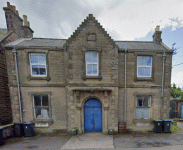
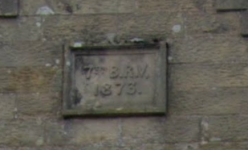
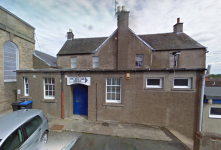
The headquarters of the battalion was moved from Duns to Coldstream in November 1876 which I think was likely to be when the Coldstream drill hall located behind the town’s church and pictured below was built – the greater accommodation here possibly being the reason for the move (but this is conjecture on my part):
In April 1880 the battalion was consolidated as the 1st Berwickshire Rifle Volunteers with the earlier seven companies now being lettered from A to G in the order of seniority which was unchanged from the list above. During April 1884 the battalion was affiliated to and adopted the uniform of the Royal Scots and in 1885 the headquarters were moved back from Coldstream to Duns.
The battalion was transferred from the Royal Scots Regimental District to that of the King’s Own Scottish Borderers and assumed the new title of 2nd (Berwickshire) Volunteer Battalion, King’s Own Scottish Borderers in May 1887 (albeit some sources note that the change did not take effect until 1888).
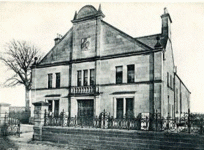
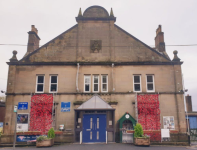
A grand new Volunteer Hall was opened in Duns on 13 February 1895 at a ceremony attended by over 1,000 people. The hall was built on a half-acre plot funded by public subscription, mostly from the people of Duns, although the largest single donation was from Lieutenant-Colonel Charles Hope who was the unit’s commanding officer from May 1887 to March 1908. This fine hall still exists – the pictures below show it on completion and how it looks today. The red panels were a temporary First World War commemoration, now removed, but sadly the later entrance canopy and tasteless blue doors remain:
Following the opening of the new drill hall, the previous location at the Militia stores at Tiendhill Green in the town was demolished in in 1895.
During the Second Boer War (October 1899 to May 1902) the battalion supplied its contingent to all the volunteer service companies of the King’s Own Scottish Borderers with a total of 80 men having served in South Africa.
- 1st Duns – formed December 1859; meeting location possibly co-located with the Militia stores at Tiendhill Green in the town.
- 2nd Coldstream – formed March 1860; meeting location likely adjacent to the church pending the hall being constructed in 1876.
- 3rd Aytoun – formed May 1860; meeting location unknown.
- 4th Greenlaw – formed February 1860; meeting location unknown.
- 5th Lauderdale – formed April 1860; meeting location unknown.
- 6th Earlston – formed June 1863; meeting location unknown.
- 7th Chirnside – formed July 1863; initial meeting location unknown until the construction of the hall in 1873.
The headquarters of the battalion was moved from Duns to Coldstream in November 1876 which I think was likely to be when the Coldstream drill hall located behind the town’s church and pictured below was built – the greater accommodation here possibly being the reason for the move (but this is conjecture on my part):
In April 1880 the battalion was consolidated as the 1st Berwickshire Rifle Volunteers with the earlier seven companies now being lettered from A to G in the order of seniority which was unchanged from the list above. During April 1884 the battalion was affiliated to and adopted the uniform of the Royal Scots and in 1885 the headquarters were moved back from Coldstream to Duns.
The battalion was transferred from the Royal Scots Regimental District to that of the King’s Own Scottish Borderers and assumed the new title of 2nd (Berwickshire) Volunteer Battalion, King’s Own Scottish Borderers in May 1887 (albeit some sources note that the change did not take effect until 1888).
A grand new Volunteer Hall was opened in Duns on 13 February 1895 at a ceremony attended by over 1,000 people. The hall was built on a half-acre plot funded by public subscription, mostly from the people of Duns, although the largest single donation was from Lieutenant-Colonel Charles Hope who was the unit’s commanding officer from May 1887 to March 1908. This fine hall still exists – the pictures below show it on completion and how it looks today. The red panels were a temporary First World War commemoration, now removed, but sadly the later entrance canopy and tasteless blue doors remain:
Following the opening of the new drill hall, the previous location at the Militia stores at Tiendhill Green in the town was demolished in in 1895.
During the Second Boer War (October 1899 to May 1902) the battalion supplied its contingent to all the volunteer service companies of the King’s Own Scottish Borderers with a total of 80 men having served in South Africa.