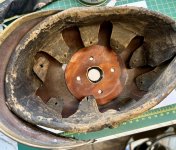
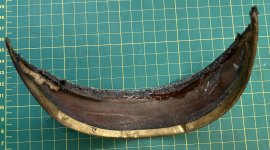
GRFP 1901 Douamont 1916

This is fascinating to me. Am so thankful Brian that you took on this restoration for me. As a new comer to this community; I am nothing but impressed by the knowledge and passion of all!
Thank you for taking on the restoration of this helmet.
Maybe one time you can tell us the story of how and where that you found it ?
Steve
 
Well, they were given to me by my parents best friends. They were huge antique collectors, items from all over the world. A fee years back they gave them to me, no history behind them (they didn't know). So i kept them on display desperately trying to find someone to restore...no luck. Then a few months ago I found out about this awesome community of Pickelhuabes. Y'all are a great group and am so impressed with knowledge and how interact on this platform!
 
Well, they were given to me by my parents best friends. They were huge antique collectors, items from all over the world. A fee years back they gave them to me, no history behind them (they didn't know). So i kept them on display desperately trying to find someone to restore...no luck. Then a few months ago I found out about this awesome community of Pickelhuabes. Y'all are a great group and am so impressed with knowledge and how interact on this platform!
Thank you for the back story
Steve
 
To my mind, the wappen is original to this helmet. As has been mentioned, those Regts issued with the new Grenadier style wappen did not replace their helmets. The new issued wappen simply had soldered loops which fit the standard infantry grommet holes. Sorry Steve, I enjoy them too much! :)
This discussion has been fascinating for me to follow! I have learned so much from this group.
 
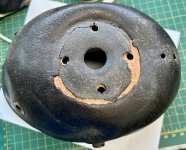
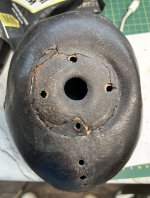
Stabilizing the top of this helmet:
IMG_4186.jpeg
This is the only way that I know of how to stabilize/solve this problem. Using the tin support disc as a template a circular patch is cut out of new leather and then stained using leather dye.
IMG_4187.jpeg
Proper leather contact cement was used here. normally, I would clamp this for drying but this is too delicate and would require special clamps.
IMG_4188.jpeg
Small pieces of original leather were taken from a donor helmet and used to fill in. Once this has dried, I will add some original shellac finish to fill in these cracks. It won't be perfect but will be covered up by the spike base and support disc. I can't fix the dent caused by the spike as this would need to be wet with a solution of water and vinegar.

 
Stabilizing the top of this helmet:
View attachment 64723
This is the only way that I know of how to stabilize/solve this problem. Using the tin support disc as a template a circular patch is cut out of new leather and then stained using leather dye.
View attachment 64724
Proper leather contact cement was used here. normally, I would clamp this for drying but this is too delicate and would require special clamps.
View attachment 64725
Small pieces of original leather were taken from a donor helmet and used to fill in. Once this has dried, I will add some original shellac finish to fill in these cracks. It won't be perfect but will be covered up by the spike base and support disc. I can't fix the dent caused by the spike as this would need to be wet with a solution of water and vinegar.

Stabilizing the top of this helmet:
View attachment 64723
This is the only way that I know of how to stabilize/solve this problem. Using the tin support disc as a template a circular patch is cut out of new leather and then stained using leather dye.
View attachment 64724
Proper leather contact cement was used here. normally, I would clamp this for drying but this is too delicate and would require special clamps.
View attachment 64725
Small pieces of original leather were taken from a donor helmet and used to fill in. Once this has dried, I will add some original shellac finish to fill in these cracks. It won't be perfect but will be covered up by the spike base and support disc. I can't fix the dent caused by the spike as this would need to be wet with a solution of water and vinegar.
Thats amazing Brian; the skill of a surgeon!
 
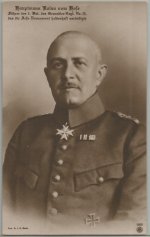
Appears to have been successful...wearing the "Blue Max". You look at the picture and try to imagine what he may have experienced. My battlefields were different than his but the nature of warfare remains the same...chaos, friction, and chance
 
The work continues:
IMG_4204.jpeg
Most of the epoxy has been removed using a knife and xacto blade. This is the best way in my experience to deal with this....the epoxy is brittle and not formulated to affix to leather fortunately! The main thing is that the stitch line is clear and all old thread removed. :) (y)
IMG_4205.jpeg
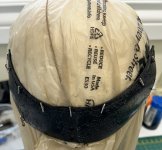
The rear visor which was totally collapsed inward was wet using the 10:1 ratio of water and vinegar (thanks again Wojtek!). As shown, the piece is then blocked on a styrofoam head and left to dry. The plastic bag keeps the leather from sticking to the foam. Prior to the restitch, the thread holes in the shell must be cleaned out. Before stitching, I am going to wet the inside rim of the shell, plastic will be placed between the liner and shell and then the piece will be blocked as above. The fragile liner must be kept dry. Drying time is basically 24 hrs. Plastic bag kindly provided by Piggly Wiggly in Fla. USA. :)
 
The work continues:
View attachment 64928
Most of the epoxy has been removed using a knife and xacto blade. This is the best way in my experience to deal with this....the epoxy is brittle and not formulated to affix to leather fortunately! The main thing is that the stitch line is clear and all old thread removed. :) (y)
View attachment 64929
The rear visor which was totally collapsed inward was wet using the 10:1 ratio of water and vinegar (thanks again Wojtek!). As shown, the piece is then blocked on a styrofoam head and left to dry. The plastic bag keeps the leather from sticking to the foam. Prior to the restitch, the thread holes in the shell must be cleaned out. Before stitching, I am going to wet the inside rim of the shell, plastic will be placed between the liner and shell and then the piece will be blocked as above. The fragile liner must be kept dry. Drying time is basically 24 hrs. Plastic bag kindly provided by Piggly Wiggly in Fla. USA. :)
I amazed at your work; the care and painstaking approach to the delicate details of the restoration process is incredible!
 
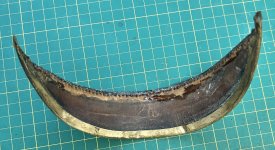
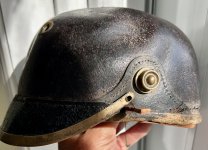
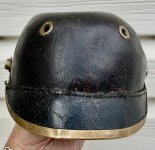
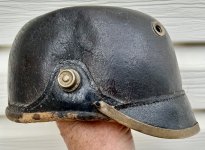
It has been a busy summer with visiting New Brunswick in July, friends and grandchildren staying over, band gigs etc. I finally got back to work on this old fellow who has seen a lot of environmental abuse. I stitched on the front visor today and left the brass trim in place while doing so. Ordinarily, I would remove it but it was very tight on the visor and the first stitch holes started at it's leading edge. After stitching 3 officer helmets this summer, it was a nice relief to tackle a simple M95 with nicely spaced holes.....none of the officer "fine stitching" to deal with. Unfortunately, it became obvious after the first pass that the leather visor has shrunken over 100+ years and now the trim will not fit properly on it. The shrinkage is close to .5" or 1cm approximately. :( The rear visor has the same problem, the stitch holes at the end of the visor no longer meet up with the first holes in the shell. The leather has been dried out and shrunk! This rear visor problem is easily dealt with but the brass front trim is a real problem. Some photos:
IMG_4231.jpeg
The front view looks ok.
IMG_4233.jpeg
Right side: If the hole section was cut off and a new hole drilled, the trim brad could be put back in.
IMG_4237.jpeg
I stuck a leather wedge into the original brad hole to show the real problem on the left side. Even if the trim was shortened, the angle shown would still not meet up with the original hole! I have to think about this but to me.....cut the trim and drill new holes in both it and the shell, install the domed brad. However, can I remove the trim without damaging the dried out visor??
Regarding the dents in the shell....I wet one, applied pressure for 24 hrs to force it back out but as you can see, no luck. This helmet is extremely dry and hard. Continued...
 
Restoration expediency at it's best:
IMG_4270.jpeg
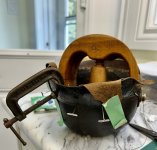
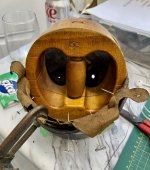
Sometimes "radical methods" have to be used to get things done. This is my 3rd attempt at lining up stitch holes on this piece which is hard and dry after 100+ years of abuse. I would start to stitch but holes just refused to line up, this despite the fact that they were lined up to start with. This visor like the front one has shrunk making things difficult. Large T pins are used to try and keep things lined up. Painter's tape to keep the dry delicate liner from flopping down over the stitch line and a "C" clamp to try and lock the visor tight to the shell. This is the first pass shown here. As I stitched past them, these pins were moved and reinserted back along the line. This is not the normal procedure but with this piece I have to keep things locked in semi alignment!
IMG_4271.jpeg
The wood hat stretcher is inserted into the middle of the shell to keep it from collapsing and screwing up the hole alignment! The first pass on any of these helmets is the most difficult.
 
Restoration expediency at it's best:
View attachment 66402
Sometimes "radical methods" have to be used to get things done. This is my 3rd attempt at lining up stitch holes on this piece which is hard and dry after 100+ years of abuse. I would start to stitch but holes just refused to line up, this despite the fact that they were lined up to start with. This visor like the front one has shrunk making things difficult. Large T pins are used to try and keep things lined up. Painter's tape to keep the dry delicate liner from flopping down over the stitch line and a "C" clamp to try and lock the visor tight to the shell. This is the first pass shown here. As I stitched past them, these pins were moved and reinserted back along the line. This is not the normal procedure but with this piece I have to keep things locked in semi alignment!
View attachment 66403
The wood hat stretcher is inserted into the middle of the shell to keep it from collapsing and screwing up the hole alignment! The first pass on any of these helmets is the most difficult.
Great job Brian, I'm picking up some great tips from watching your fine work.
 
Back
Top