

You are using an out of date browser. It may not display this or other websites correctly.
You should upgrade or use an alternative browser.
You should upgrade or use an alternative browser.
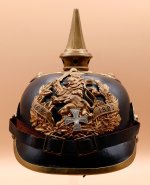
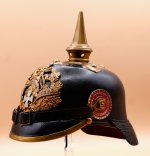
Hessian Landwehr
- Thread starter 911car
- Start date

GardeUlan
Well-known member
T
Best wishes,
GardeUlan
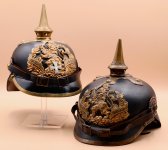
Thank you very much for showing! Great helmets! I like Hessian helmets a lot, especially IR 117. That’s mine.For those of you who like Hessian helmets, I thought I should present, in parallel to the post on the Aalter JR117 helmet, an example of the reserve version.
View attachment 66992
View attachment 66993
Best wishes,
GardeUlan
Attachments

2nd.Leibhusar
Well-known member
Stunning pair, Bruno  ...
...
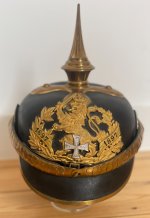
...Great officer helmet, GardeUlan! I am still looking for such a nice one.T
Thank you very much for showing! Great helmets! I like Hessian helmets a lot, especially IR 117. That’s mine.
Best wishes,
GardeUlan


Stosstrupp
Active member
Great helmets 
GardeUlan
Well-known member
That's a very good question. When I look at the helmets shown on the internet, there seem to be two variants of the „1697“ on the officer helmets. My guess is that the Wappen were produced by different manufacturers.I noticed for the first time that on enlisted helmet plates, 1697 is written in italic font, while 1897 is not. On the officer helmet (see post by GardeUlan), none of the dates is written in italic characters. Why is that?..
There is the version where the year is incorporated in the Wappen and the version where the year was simply soldered on at the back.

Hesse Darmstadt Pickelhaube / Spiked Helmet for Officer in Infanterie
This is a very tasty Infanterie-Regiment Nr 117 officer’s pickelhaube from the Grand Duchy of Hesse-Darmstadt. The regiment was officially known as Infanterie-Leib-Regiment Großherzogin (3. Großherzogl. Hessisches) Nr 117. Although it was numbered as Hesse-Darmstadt’s THIRD infantry regiment, it...
derrittmeister.com
Hessen großes Helmemblem für eine Pickelhaube für Offiziere im Infanterie-Leibregiment Großherzogin (3. Großherzoglich Hessisches) Nr. 117 - Hessen-Darmstadt - Imperial Germany & Weimar Republic: insignia, epaulettes, equipment, etc. - Military Anti
Hessen großes Helmemblem für eine Pickelhaube für Offiziere im Infanterie-Leibregiment Großherzogin (3. Großherzoglich Hessisches) Nr. 117 Um 1910. Vergoldete Ausführung mit durchbrochener Krone für Offiziere, seitlich mit aufgelegten Bandeaus "1967 -
 www.weitze.com
As I said, that's just a guess, and the reference from the dealers is always a tricky thing.
Best wishes
GardeUlan

argonne
Well-known member
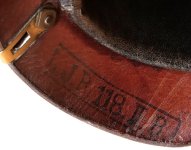
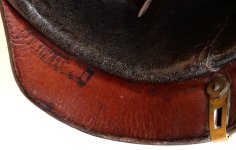
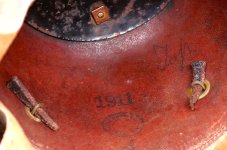
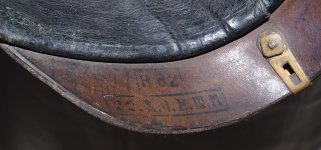
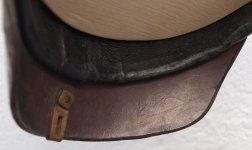
Bruno,No known geographic origin for this one, but possibly the owner's name inside the shell (?).
View attachment 66999
There are three guys with the name Jost in the II/LJR118:
Heinrich from Darmstadt, 8/ LJR118, wounded near Vitry-le-Francois and Fontaine between 4 and 16 September 1914:
Verlustlisten 1. Weltkrieg, page 1199: Jost Heinrich (Darmstadt)
Verlustlisten 1. Weltkrieg, page 1615: Jost Heinrich ()
Then taken prisoner:
Verlustlisten 1. Weltkrieg, page 11492: Jost Heinr. (Darmstadt)
Johann Andreas from Finthen / Mainz, 5/LJR118, KIA nearly at the same period (septembre 1914):
And Wilhelm from Wirbelau, 6/LJR118, wounded and taken prisoner between 8 and 28.9.14 during following fights: Vitry, Cernay-Rouvray, Maisons de Champagne:
Verlustlisten 1. Weltkrieg, page 1924: Jost Wilhelm (Wirbelau)
Verlustlisten 1. Weltkrieg, page 7057: Jost Wilhelm (Wirbelau)
Philippe
argonne
Well-known member
Re-
Archives at the CICR for Heinrich Jost, 8/LJR118:
 grandeguerre.icrc.org
grandeguerre.icrc.org
And for Wilhelm Jost, 6/LJR118:
grandeguerre.icrc.org
grandeguerre.icrc.org
grandeguerre.icrc.org
grandeguerre.icrc.org
grandeguerre.icrc.org
grandeguerre.icrc.org
grandeguerre.icrc.org
grandeguerre.icrc.org
grandeguerre.icrc.org
Philippe
Archives at the CICR for Heinrich Jost, 8/LJR118:
Zoomer
grandeguerre.icrc.org
Zoomer
grandeguerre.icrc.org
And for Wilhelm Jost, 6/LJR118:
Zoomer
grandeguerre.icrc.org
Zoomer
grandeguerre.icrc.org
Zoomer
grandeguerre.icrc.org
Zoomer
grandeguerre.icrc.org
Zoomer
grandeguerre.icrc.org
Zoomer
grandeguerre.icrc.org
Zoomer
grandeguerre.icrc.org
Zoomer
grandeguerre.icrc.org
Zoomer
grandeguerre.icrc.org
Philippe
Re-
Archives at the CICR for Heinrich Jost, 8/LJR118:
Zoomer
Zoomer
And for Wilhelm Jost, 6/LJR118:
Zoomer
Zoomer
Zoomer
Zoomer
Zoomer
Zoomer
Zoomer
Zoomer
Zoomer
Philippe
Thank you, Philippe. Amazing details as ever.
Care to wounded Germans by the French in WW1 is a little-known topic, at least of me. The First Geneva Convention was obviously already enforced. Prolonged medical care was performed far away from battlefields, then I suppose they all became prisoners of war in remote locations (Belle-Isle en Mer!). From your documents, the French also alerted German families in case of death. Past emergency care, were some wounded soldiers transferred to German medics? How about the other way around? Were French victims treated the same by the Germans? Many questions...
argonne
Well-known member
Bruno,Thank you, Philippe. Amazing details as ever.
Care to wounded Germans by the French in WW1 is a little-known topic, at least of me. The First Geneva Convention was obviously already enforced. Prolonged medical care was performed far away from battlefields, then I suppose they all became prisoners of war in remote locations (Belle-Isle en Mer!). From your documents, the French also alerted German families in case of death. Past emergency care, were some wounded soldiers transferred to German medics? How about the other way around? Were French victims treated the same by the Germans? Many questions...
Based on my knowledge following extensive research in the CICR lists, the following facts can be stated/confirmed:
The wounded German prisoners were mostly treated in the same way as the wounded French soldiers. Not necessarily by German doctors who were also prisoners, but mostly by French army medical personal.
There were also a number of prisoner exchanges between Germany and France when it became apparent that soldiers were so disabled and unfit for combat that medical care was becoming too intensive, time-consuming, and expensive. In this case, soldiers who were to be exchanged had to swear on their honor never to return to service in a combat unit. (I am owning one or two named helmets of such tracked and traced wearers).
I also observed a number of cases where military medical personal taken prisoner, such as stretcher bearers and doctors, even if they were not wounded, were entitled to be repatriated under special agreements between France and Germany.
And indeed, there was a very significant exchange of informations between the two warring parties, through the Red Cross, to inform families of the deaths of their sons, husbands, brothers, etc.
Even when, following a very brutal local offensive, during which a piece of land was conquered and it was initially impossible to immediately determine the identity of the enemy dead littering the newly conquered terrain, later, when there was time to bury or exhume the bodies of the enemy killed in action, all the information gathered on the mortal remains, such as letters, military papers, watches, or rings engraved with a name, allowing for reliable identification,were forwarded as far as possible to the CICR, which promptly informed the ennemy military authorities, who in turn informed the civil authorities of the place of birth or residence of the deceased soldiers in order to officially record the deaths. For example, in my collection I have a named helmet bearing the name of a silesian soldier of the III/RJR22 (12K) who went missing on May 14, 1915, on Loretto Hill and was only officially declared dead to the German civil authorities two years later, as a personal item was apparently lately found on his remains, allowing for certain and definitive identification.
Philippe
Last edited: