Pickelhaube M1860 rosette question

koeniggratz

New member
Hello,

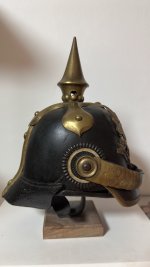
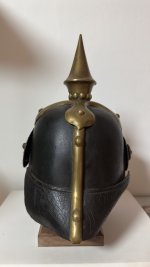
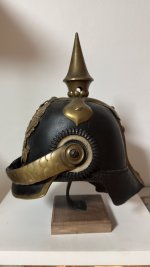
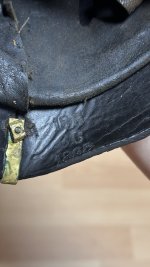
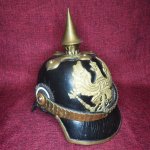
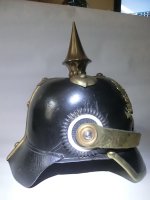
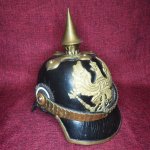
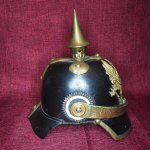
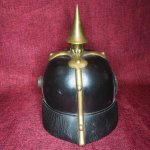
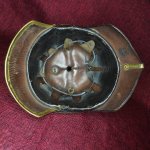
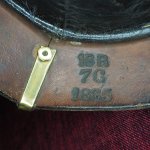
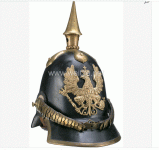
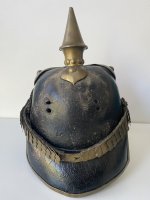
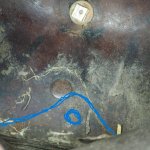
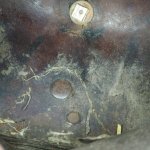
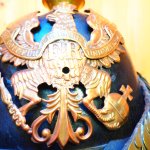
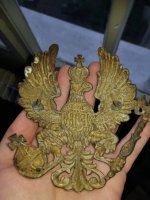
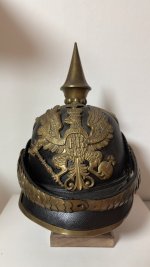
I have a Prussian M1860 Pickelhaube for infantry. It has two rosettes, although there should normally be only one. From what I understand, the larger rosette is an older type, but I’m not sure how much older it is.

The diameter of the larger rosette is 7.45 cm, while the smaller one measures 6.5 cm.


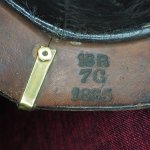
The helmet most likely belonged to the 18th
Poznan Infantry Regiment.


Thank you very much
 

Attachments
  • IMG_1406.jpeg
    IMG_1406.jpeg
    4.9 MB · Views: 43
  • IMG_1411.jpeg
    IMG_1411.jpeg
    4.2 MB · Views: 39
  • IMG_1412.jpeg
    IMG_1412.jpeg
    4 MB · Views: 35
  • IMG_1409.jpeg
    IMG_1409.jpeg
    4.2 MB · Views: 35
  • IMG_1413.jpeg
    IMG_1413.jpeg
    4.7 MB · Views: 37
  • IMG_1414.jpeg
    IMG_1414.jpeg
    2 MB · Views: 42
Last edited:
Hello,

Indeed, there are a few easily fixable issues.

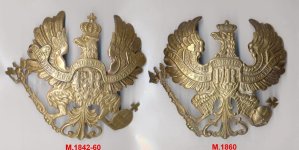
The 75 mm cockade is the 1842 model. Made of iron, it is an M42/57. The 65 mm cockade is the 1860 model, reduced in size due to the reduction in the height of the shell in 1856 and then again in 1860.

The chin strap appears to be the M42 given its width, but the rosettes are definitely M60s. It is clear that they are too small in relation to the width of the first scallop.
And one final observation:
The tip is still the large M42 cruciform lanceolate tip, but it was shortened in height in 1957 or 1960. It is clear that the Perlring slightly covers the side ventilation hole, whereas it should be well below it.

Here is mine :
M60  18JR 1865.JPGM60 18JR Z1.JPGM60 18R Z1 1865.JPG

In 1870, this regiment took part in the siege of Phalsbourg (Lorraine).
 
Hello,

Indeed, there are a few easily fixable issues.

The 75 mm cockade is the 1842 model. Made of iron, it is an M42/57. The 65 mm cockade is the 1860 model, reduced in size due to the reduction in the height of the shell in 1856 and then again in 1860.

The chin strap appears to be the M42 given its width, but the rosettes are definitely M60s. It is clear that they are too small in relation to the width of the first scallop.
And one final observation:
The tip is still the large M42 cruciform lanceolate tip, but it was shortened in height in 1957 or 1960. It is clear that the Perlring slightly covers the side ventilation hole, whereas it should be well below it.

Here is mine :
View attachment 70862View attachment 70861View attachment 70863

In 1870, this regiment took part in the siege of Phalsbourg (Lorraine).
Thank you for the information and photos. Very helpful!
 
Hello,
This helmet does indeed have a few minor issues that can be corrected.
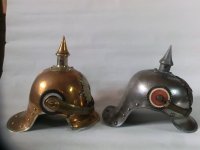
The 75 mm cockade is still the same size as the M42. But in 1956, it was no longer made of leather but of iron, as shown here. In 1860, the Prussian helmet was further reduced in height and weight. The cockade was reduced to 65 mm. Therefore, the 75 mm cockade must be removed, leaving the other one on the right side.
The chin strap is too wide, and the scales should have been completely flat since 1856. It is also clear that the rosettes are too small in relation to the first festoon.

Two comments:
---The spike is still the old M42 spike, shortened. It is clear that the Perlring partially obstructs the ventilation hole, whereas it should be completely below it.
---The eagle is the old M42 but with the Vaterland-Bandeau added (soldered with tin).


Mine, on the other hand, is a new M60, which is lighter, with a slightly smaller tip and cruciform base. The eagle is the new M60 design from November, with the Vaterland-Bandeau stamped on it. Both of our helmets are from the same year, 1865; only the company has changed.
M60  18JR 1865.JPGM60  18R  1865  Z1.JPGM60  18R  Bibi.JPGM60  18R 1865  Z1 Bibi.JPGM60 18R Z1 1865.JPG
This helmet is the one on page 16 of Volume 1 by Jean-Louis Larcade. 😇

In 1870, the 18R at that time, garrisoned in Schweidnitz and Reichenbach, took part in battles in Lorraine, notably the siege of Phalsbourg.

(Please excuse the repetition, but I thought I had accidentally deleted the previous post. )
 
Last edited:
Hello,
This helmet does indeed have a few minor issues that can be corrected.
The 75 mm cockade is still the same size as the M42. But in 1956, it was no longer made of leather but of iron, as shown here. In 1860, the Prussian helmet was further reduced in height and weight. The cockade was reduced to 65 mm. Therefore, the 75 mm cockade must be removed, leaving the other one on the right side.
The chin strap is too wide, and the scales should have been completely flat since 1856. It is also clear that the rosettes are too small in relation to the first festoon.

Two comments:
---The spike is still the old M42 spike, shortened. It is clear that the Perlring partially obstructs the ventilation hole, whereas it should be completely below it.
---The eagle is the old M42 but with the Vaterland-Bandeau added (soldered with tin).


Mine, on the other hand, is a new M60, which is lighter, with a slightly smaller tip and cruciform base. The eagle is the new M60 design from November, with the Vaterland-Bandeau stamped on it. Both of our helmets are from the same year, 1865; only the company has changed.
View attachment 70864View attachment 70865View attachment 70866View attachment 70867View attachment 70868
This helmet is the one on page 16 of Volume 1 by Jean-Louis Larcade. 😇

In 1870, the 18R at that time, garrisoned in Schweidnitz and Reichenbach, took part in battles in Lorraine, notably the siege of Phalsbourg.

(Please excuse the repetition, but I thought I had accidentally deleted the previous post. )
Sorry Thierry, but I have a different opinion about the 1st reduction of the cockade diameter. Contemporary sources indicate that the diameter of the cockades was firstly reduced with the introduction of the helmet M1867 (down to 50 mm).
I have searched through many contemporary sources, but I couldn't find any indication that the cockade diameter was reduced before 1867. While several sources on the introduction of the M1867 mention a reduction of the cockade diameter, not a single one about the introduction of the M1860 wrote about such a reduction. And as it was mentioned in 1867, I assume that such a change would have been mentioned around 1860 as well.
However, even if there is no doubt that some M1860 helmets were found with smaller cockades around 60 to 65 mm, this was actually against the regulations. But as in other cases too, such a minor deviation was overlooked by the responsibles. Despite their precise specifications in the regulations, the Prussians were surprisingly tolerant when it came to deviations from them.
 
Sorry Thierry, but I have a different opinion about the 1st reduction of the cockade diameter. Contemporary sources indicate that the diameter of the cockades was firstly reduced with the introduction of the helmet M1867 (down to 50 mm).

I understand you, Sandy. I know the "infantry" roundel is 51 cm. The large 75mm roundel is found on M42 helmets, and the M56/57 was initially reduced in height.So how do we explain the common presence of 65cm roundels on M60 helmets?
How can we explain that most of the M60s found here, during the siege of Metz in August and September 1870, show 63-65mm roundels?
 
I understand you, Sandy. I know the "infantry" roundel is 51 cm. The large 75mm roundel is found on M42 helmets, and the M56/57 was initially reduced in height.So how do we explain the common presence of 65cm roundels on M60 helmets?
How can we explain that most of the M60s found here, during the siege of Metz in August and September 1870, show 63-65mm roundels?
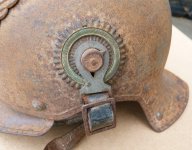
These cockades, measuring 65 mm in diameter, probably originate from the metal helmets that were introduced in 1862. They were then probably also sometimes used for the M1860 leather helmet. But there are also plenty of M1860 helmets that have the correct metal cockades with a diameter of 75 mm.
However, as I have already written the rules at that time weren't nearly as strictly followed as they were written. A similar example is the Bavarian chapka emblem, which was sometimes worn on the Pickelhaube around 1900, contrary to regulations.
I think the manufacturers simply took the cockades off a shelf without giving much thought to the fact that there were different diameters for cavalry and infantry helmets. But perhaps it was also intentional, in line with their own fashion tastes. But there is no evidence of an official introduction of this cockade for leather helmets, either in the official regulations or in military magazines.
 
Thanks, Sandy.

Yes, I think it was a wartime adaptation, as the 75mm gun had become really enormous on smaller helmets. It's like the M60 shells that were flipped and disguised as M67s. We can see the reality of the situation, but the AKO (Armored Design Manual) for the M67 only describes the new helmet.
 
Isn't the helmet which started this thread a M56/57? Or at least the Wappen? It has the added bandeau.

I have several M60s with a leather cockade. I actually like to see that, and I have another in the mail from an old Franco-Prussian War collection I've been tapping into. And it's a Dragoon example. Honestly, I think firm rules during that era weren't a priority or a concern. They improvised and put everything to use. IMO.
 
Last edited:
Isn't the helmet which started this thread a M56/57? Or at least the Wappen? It has the added bandeau.
Here is an M42, unmodified. Shell-shaped shell, visor, and very high neck cover. The helmet had to be worn backwards so as not to blind the soldier!!!
M42 Prusse Ligne Z2 6500€.GIF


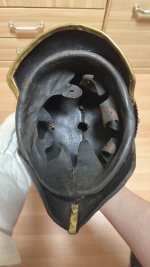
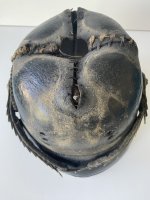
-Regarding the helmet, it is a shell constructed after the 1857 reduction in size. This reduction involved cutting the shell from the top, specifically by cutting the leather in a cross shape to bend the four points, thus making the helmet less ogival. In this case, a cross-shaped seam is visible from the inside.M42-57 PHcom 0ldenburg 23.jpeg The four arms of the cross are flattened toward the tip and more curved at the end, near the screw heads. M42-57réduc par le haut.jpeg In 1960, a new helmet was introduced that was lower and lighter. The old M42/57 helmets were shortened by 2 cm, but this time at the bottom. The neck cover and visor were re-sewn but also reduced by 2 cm. In this case, the bell-shaped reinforcements at the chin strap attachment were unstitched and reattached, and a new hole was drilled above the old one.
M42~60 par le bas - Copie.JPGM42~60 par le bas.JPG The new helmets manufactured in 1860 are obviously lighter in origin and without these marks.

---
The AKO of May 1860 prescribed the Vaterland-Bandeau with the motto “Mit Gott für Koenig und Vaterland.” Initially, the bandeau was soldered onto the M42 eagle, and a new eagle was manufactured with the bandeau stamped onto it.
On November 4, with the new lighter and lower helmet, a new design appeared, featuring the real line eagle, which would remain on the helmets of the Cuirassiers for a long time to come.
Here is the M42 eagle with the VB from May 1960 added.
AdlerM42-60 trace de LWK bibi.JPG
Below, the first model of the M60 eagle from May, shown from behind to clearly show the stamp on the brass plate, integrated into the design of the M42 eagle. It was this first version (May to November) that was replaced by the new design, which is the true Linien-Adler M60 (from November 4).
Aigle M60-MAI à NOVEMBRE.jpg
It was this first version (May to November) with VB integrated or added by soldering (left) that was replaced by the new design, which is the true Linien-Adler M60 (from November 4) identical to that of the infantry and cuirassiers until 1867 (right). After 1867, it remained in use only among the cuirassiers.
ADLER42-5à11-   60 &nouveau60.jpg
 
Last edited:
I have several M60s with a leather cockade. I actually like to see that, and I have another in the mail from an old Franco-Prussian War collection I've been tapping into. And it's a Dragoon example. Honestly, I think firm rules during that era weren't a priority or a concern. They improvised and put everything to use. IMO.
My GKR and GdC helmets, an M62/67 and an M67, both have 70mm leather cockades!!! Whereas they should have 60-63mm metal cockades! In Larcade Volume 2, page 15, we read that in order to avoid scratching the tombac (soft metal) shells, the cockades of the Bodyguard and Cuirassier Guards were made of leather. The 70mm size may be a reduction from the 75mm size of the M42s. GKR# M62-67 et M15.JPG
The 63mm cockade on the GKR M15 is compliant, but you often find ones with 48mm cockades, which are more discreet! The 70mm leather cockade on the GKR M67 is not compliant in terms of either size or material... because since 1856, cockades should be made of sheet steel.
Jäeger zu Pf M15 coc inf 48mm.jpg
 
Thanks for all the information and photos!! I reviewed some of my helmets. The one which has the 42/56 Wappen did not have the other features (not sure about the top cross) you described. No visible leather modifications. I also have a M42.

All my Kürassier M1867s have metal cockades. 3 are M1867s (1 officer and 2 EMs) representing the 2nd, 1st, and 6th Regiments, and my 4th one is a M62/67 (might be a 53/62/67). It is a GdC marked example with both the eagle and the spike.

I'll do some more examining....
 
Back
Top