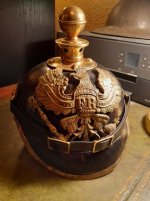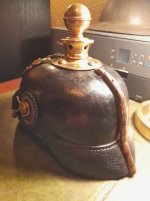
A M95 artillerie haube is my latest addition.

I just bought this nice looking arty M95 haube, marked FAR11.
More pictures will follow when it has arrived at my place. No chinstrap or kokarden, but I have those here.
It has a vent on the rear spine.

I wish all of you a merry christmas!

Regards, Coert.
Nice addition Coert! Early Santa present to yourself. You must have been a good boy in 2025!
😎
 
Nice addition Coert! Early Santa present to yourself. You must have been a good boy in 2025!
😎
Well I guess so Francis. Or Santa thought that I have had enough troubles these last couple of years.
It was really cheap too, so I got lucky. It was below 500€, so I snapped it up real fast! It also has nice kammer stamps. :) (y)
No double holes.
 
Well I guess so Francis. Or Santa thought that I have had enough troubles these last couple of years.
It was really cheap too, so I got lucky. It was below 500€, so I snapped it up real fast! It also has nice kammer stamps. :) (y)
No double holes.
Great!
Indeed: Stamps are always nice to find!
 
But now the big question, regarding the vent on the rear spine. Fuss or Feldartillery?
I know one doesn't have that vent, the other does have it.
 
I just bought this nice looking arty M95 haube, marked FAR11.Elle possède une aération sur la colonne vertébrale arrière.

Fussartillerie is walking, so they have a vent.

***The Feld-Artillery was the mobile artillery, including horse-drawn, mounted, and towed artillery, used to support the infantry.
F.A.R. (Feld-Artillerie-Regiment) = rear spine without ventilation, convex chinstrap scales, belt, boots, and cavalry saber.

***Foot artillery was the heavy artillery, siege artillery, fortress artillery, and later, heavy artillery mounted on railways (such as the Big Bertha, Lange Max, etc.).
A.F. (Artillerie zu Fuß) = rear spine with ventilation, flat chinstrap scales, infantry belt or boots, and a short Faschinenmesser.

*The FAR 11 was supposed to have a rear spine without a ventilation flap. But during the mobilization, in the rush, "composite" helmets were distributed in August 1914, because it was necessary to equip thousands of reservists and new regiments for which there had not been enough equipment.
*We will have to see the stamp, because it could be the 11 A.F., that is to say the Artillerie zu Fuß-Régiment.


Merry Christmas
 
Last edited:
Beautiful Coert, your Christmas came early, I hope he still has time with his sleigh to leave something behind via Belgium, it shouldn't be much, I'm easily satisfied, but still, you received something nice from Santa, I'll be on guard, who know
 
***The Feld-Artillery was the mobile artillery, including horse-drawn, mounted, and towed artillery, used to support the infantry.
F.A.R. (Feld-Artillerie-Regiment) = rear spine without ventilation, convex chinstrap scales, belt, boots, and cavalry saber.
***Foot artillery was the heavy artillery, siege artillery, fortress artillery, and later, heavy artillery mounted on railways (such as the Big Bertha, Lange Max, etc.).
A.F. (Artillerie zu Fuß) = rear spine with ventilation, flat chinstrap scales, belt, boots, and a short Faschinenmesser.

*The FAR 11 was supposed to have a rear spine without a ventilation flap. But during the mobilization, in the rush, "composite" helmets were distributed in August 1914, because it was necessary to equip thousands of reservists and new regiments for which there had not been enough equipment.
*We will have to see the stamp, because it could be the 11 A.F., that is to say the Artillerie zu Fuß-Régiment.


Merry Christmas
Thanks for the info Thierry! I will make photo's of the markings, (when the helmet is here) as the pictures in the ad on ebay.fr were not really clear. They seem to be FAR11 though. (y)
 
Well, I looked at the markings, and here's a picture of the one which make it clear, I presume.
It reads FA 11.
 

Attachments

Back
Top