Kraftfahrer Battalion M95

b.loree

Administrator
Staff member
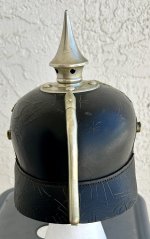
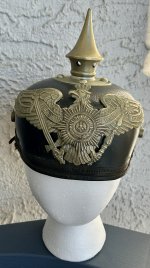
Another restoration project from Alan S. The "before" photos:
IMG_4539 2.jpeg
IMG_4540 2.jpeg
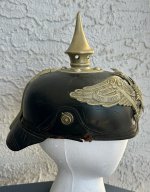
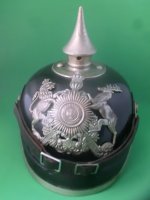
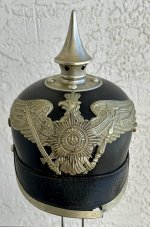
This is an extremely rare helmet from the “Motor Vehicle Driver" Battalion. I have seen numerous photos of these individuals in their "driver uniforms" which are often leather "car coats". Unfortunately, I have never seen a driver wearing a pickelhaube. Perhaps one of our members can post one here. This helmet is date stamped 1911 an is in the M95 style of helmet.
IMG_4543.jpeg
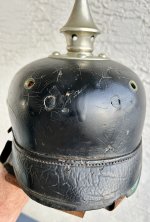
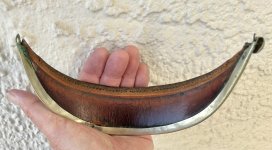
Both visors on this piece need to be restitched. As we see above the front visor has been glued on in the past. Unfortunately, the silver trim has also split in two.
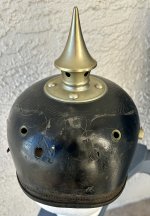
IMG_4544.jpeg
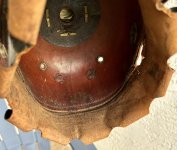
For some reason, we see an extra set of holes in the front of the shell. However, the original holes are the grommeted ones and the wappen fits these exactly. There are 2 "plugs" for these holes which have been glued in. One of these has popped out in transit but I am going to secure these as part of the restoration.
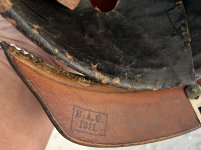
IMG_4550.jpeg
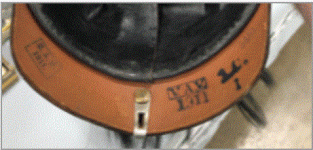
The BAG acceptance stamp and 1911 date.
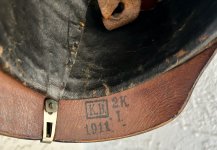
IMG_4549.jpeg
Beautiful pre war markings: Kraftfahrer Battalion, 2nd Kompanie (Condition 1) 1911, the year that the helmet was accepted into Batt. Stores. To be continued....
 
Last edited:
Bravo, very nice helmet !

A small correction: this is not a Guard helmet. In 1914, the German army had a motor vehicle battalion. This unit consisted solely of passenger cars, intended mainly for transporting generals and their respective staff. This battalion was stationed in Berlin, which explains the B.A.G. stamp.
One detachment of this Prussian battalion was Saxon, another was Württemberg, and there was also a Bavarian company.
The helmets worn by these drivers were those of the railway engineers (Prussian, Saxon, and Württemberg) and those of the balloonists for the Bavarian company.
This helmet is therefore a Prussian “automobile driver” helmet. As with the Eisenbahn, it bears a Garde-Adler mit Garde-Stern, without actually belonging to the Guard.
The two filled-in holes could be explained by the recycling of an old helmet from the Saxon detachment. (traces of the M95 eyelets are still visible).

Infra, Eisenbahn, same principle as KraftfahrerEisenb.R  Comp Sax et Wûrt.jpg
 
Last edited:
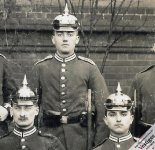
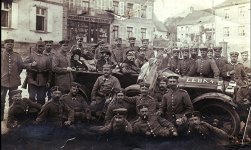
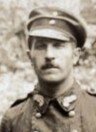
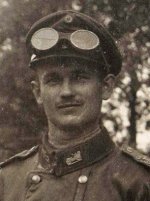
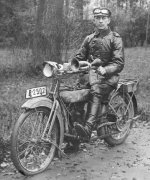
In fact, the spiked helmet was worn for formal occasions and ceremonies. For everyday service, soldiers wore flat caps and goggles such as Climax, Aviator Goggle, Baruffaldi, etc. The same was true for train drivers and motorcycle couriers, as spiked helmets were not practical. conducteur.JPG Radfahrer.JPG
 
In fact, the spiked helmet was worn for formal occasions and ceremonies. For everyday service, soldiers wore flat caps and goggles such as Climax, Aviator Goggle, Baruffaldi, etc. The same was true for train drivers and motorcycle couriers, as spiked helmets were not practical. View attachment 71828 View attachment 71829

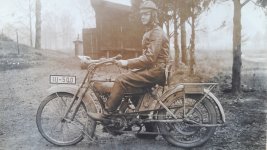
Very nice pictures. Any clue as to the meaning of L.E.B.K 4. painted on the automobile?
Baruffaldi and Climax goggles are still made today for motorcyclists.
 
Hello Bruno,
No, I've obviously thought about the meaning of the acronym LEBK4, but I haven't found an answer. I'll look into it.

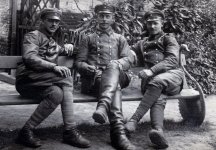
Note that the second photo shows collars with metal motorcycles pinned to them. These are therefore motorcycle dispatch riders, but their uniforms were identical to those of the car drivers
.- Motorradfahrer moto au col.JPG


Generals' motorists and drivers wore an automobile clipped to their collar, otherwise the outfit was identical, except for the leather breeches for motorcyclists.
- Kraftfahrer Auto au col.jpg
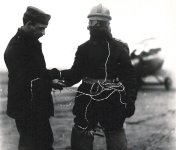
For motorcyclists, drivers, aircrew, etc., the spiked helmet or the Tchako was part of their dress uniform for outings or parades. The motorcycle helmet was the standard headgear, as was the pilot's helmet, and the cap for drivers. These technicians therefore had at least one additional head covering.

Motorradfahrer   sur NSU.jpg
Flieger.jpg
 
Hello Bruno,
No, I've obviously thought about the meaning of the acronym LEBK4, but I haven't found an answer. I'll look into it.

Note that the second photo shows collars with metal motorcycles pinned to them. These are therefore motorcycle dispatch riders, but their uniforms were identical to those of the car drivers
.View attachment 71836


Generals' motorists and drivers wore an automobile clipped to their collar, otherwise the outfit was identical, except for the leather breeches for motorcyclists.
View attachment 71835
For motorcyclists, drivers, aircrew, etc., the spiked helmet or the Tchako was part of their dress uniform for outings or parades. The motorcycle helmet was the standard headgear, as was the pilot's helmet, and the cap for drivers. These technicians therefore had at least one additional head covering.

View attachment 71837
View attachment 71838
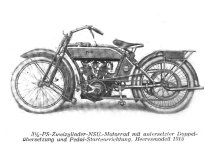
Probably the same motorcycle as in your picture. Twin-cylinder NSU, 3.5 PS (Pfaederstarke, the German metric almost equivalent of HP). 1917 model.

1009 Krad 03.jpg
 
Obviously :rolleyes:
I had found the answer for Landwehr, but for E, I hesitated with Ersatz, B with Bataillon, K with Kraftfahr... Thank you Philippe.

Bruno, yes, that's right, an NSU, which was the standard-issue motorcycle for the army.
Moto allemande NSU réglo1915.jpg


Notice the belt drive, very modern for its time, which I also saw in the 2000s on Harley Davidson "Fatboy" models.
 
I'm returning to the topic of the spiked helmets of the Kraftfahrer Bataillon. There were three companies in Berlin:

---One Prussian (Prussian Eisenbahn helmet)
---One Saxon (Saxon Engineer helmet)
---One Württemberg (Württemberg Eisenbahn helmet)
Here is the one from the Württemberg company; it's the same as the Eisenbahn of the same state. Engineer's helmet, nickel silver trim, but with the Württemberg star (identical to the DR26).
Kraftfahrer Bat Wurt Cie Berlin.JPG
VAV VersuchsAbt Verkehrstruppen.GIF

The Bavarian Motorists also had a company, but I think it was stationed not in Berlin, but in Munich (to be verified). According to J-L-Larcade, Tschako's nickel silver trim was similar to that used by the Bavarian technical troops.
To differentiate them from E.R. (Eisenbahn-Regiment 1-2-3-4) we have either K.B. (Kraftfahrer-Bataillon ) and/or V.A.V. ( Versuchs-Abteilung-Verkehrstruppen) .
 
Last edited:
Thanks for taking on this project Brian! I greatly appreciate your willingness to share your exceptional skills and knowledge in restoring this helmet for me! I greatly appreciate this!

Best Wishes,

Alan
 
Thanks, Thierry, for sharing this great information. Thanks also for sharing the great period photos of kraftfahrer personel, and their headgear, goggles, and collar insignia, as well as the photos of the rare Wurttemberg helmet.

Thanks, Bruno, for sharing this great period photo of the NSU motorcycle!

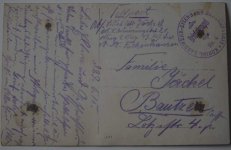
Thanks, Philippe, for sharing this rare unit stamp on the back of the postcard!

Best Wishes,

Alan
 
Yes, unlike many French collectors who are only interested in the helmets and uniforms of regiments that fought... in their own backyard... I collect spiked helmets and German imperial headgear from all sides. Therefore, I've taken an interest in Eisenbahn (railway), Fahrräder (railroad), but also Feuerwehr (fire brigade), Polizei (police), Customs, etc. :unsure: Especially since many of them were "militarized" during the mobilization of August 2, 1914.
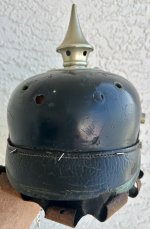
 
IMG_4572.jpeg
Stitch holes cleasned out and ready for stitching.
IMG_4569.jpeg
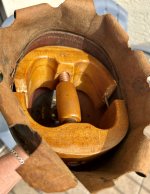
Stitching is done with an antique hat stretcher in place. The stretcher as shown is angled so that I can access the stitch line. This helmet was tending to collapse inwards as usual. The stretcher keeps the proper shape for stitching the visor on. It makes no sense to restitch the visor back on without doing this. The new stitching will also help keep the shell open as it should be.
 
I finished this piece in the last few days. Some photos:
IMG_4580.jpeg
The original plug for the left extra hole had fallen out in transit, this was glued back into position. The mdern glue residue should have beenhidden with a bit of shoe polish but I don't have any with me. A modern leather glue was used here. Unfortunately, somehow the front edge of the visor has had a piece chipped from it. :(
IMG_4582.jpeg
Circular patches of thin leather were cut and glued into position backing the plugs. This is the correct method found on originals and this stabilizes everything. The liner here is fragile and great care had to be taken when stitching. This is typical as the extra thread always catches on these liner tongues, the spike, side posts etc. When thread catches, you must never get aggressive with it, always carefully free it from what ever it is caught on. It is very easy for the thread to cut through this old leather. In extreme cases thread can cut right through one of these tongues! :(
IMG_4583.jpeg
In the past someone soldered this split trim, we really need to find a new original piece. The solder was already broken when I got this helmet but the restitch has exacerbated the problem. I may have a piece at home :unsure:
IMG_4585.jpeg
The spine must be removed to restitch a rear visor. However, you only need to remove one spike base brad and then slide the tongue at the end of the spine out from underneath the base. The bottom tongue has to be carefully bent vertical to free it from the visor. When replacing the spine, insert the spike base tongue first, then the soldered middle split pin and last re bend the bottom tongue around the visor. Sometimes re screwing the square nut back on can be a real pain! :)
 
Wow, Many thanks Brian for another exhibit of fabulous and patient workmanship with your amazing skills! Thanks for doing work!

I probably have a piece of neusilber visor trim which I could send down to you. Do you have your cutters with you? I totally forgot to send you a replacement piece when I mailed the helmet to you. Shall I send you a new visor trim piece to you?

Thanks again for your amazing workmanship!

Best Wishes,

Alan
 
Back
Top