The Kurassier pallasch

cptbob

Well-known member
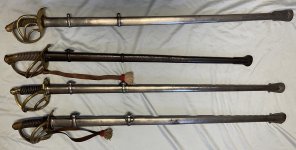
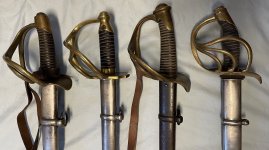
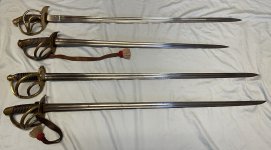
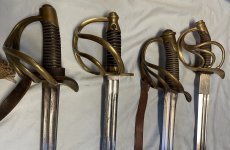
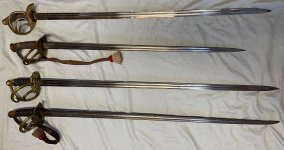
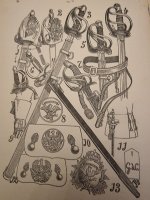
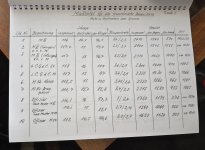
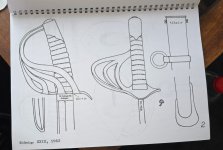
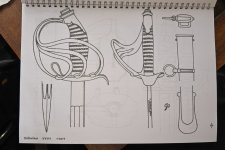
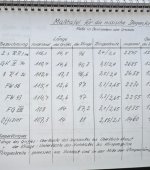
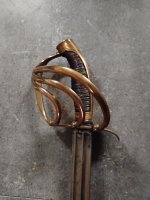
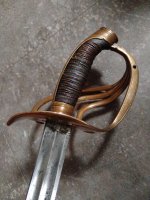
From the bottom up (or left to right).
The 1817 French form. Carried by the GdC and Regiments 1, 3 and 7.​
The 1819 Russian form. Carried by the GKR and Regiments 2, 4, 5, 6 and 8.​
The 1854. Captured from the French in 1870/71 they were adopted in 1876. In 1896 the blades were shortened.​
Officer's private purchase pallasch.​

IMG_6978_50.jpgIMG_6979_50.jpgIMG_6980_50.jpgIMG_6981_50.jpgIMG_6982_50.jpg
 
Hello Dear Colleagues,

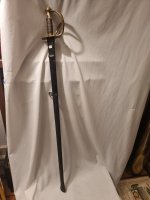
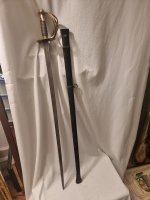
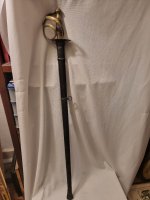
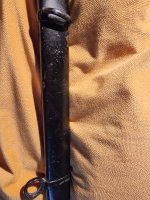
The saber of cuirassiers of the so-called Russian form, as it seems, should probably have two rings for the sling?
Is the thimble here in place of the upper ring a cause for concern?
I would be grateful for any comments.
 

Attachments

  • 35465024_20260211_093322_3058018_resized_1.jpg
    35465024_20260211_093322_3058018_resized_1.jpg
    107.3 KB · Views: 16
  • 163130209_20260212_095438_2150561_resized.jpg
    163130209_20260212_095438_2150561_resized.jpg
    125.5 KB · Views: 16
  • -1027219339_20260211_093359_3038840_resized_1.jpg
    -1027219339_20260211_093359_3038840_resized_1.jpg
    105.2 KB · Views: 18
  • -1382235257_20260211_093333_4325839_resized_1.jpg
    -1382235257_20260211_093333_4325839_resized_1.jpg
    147 KB · Views: 18
  • 234150879_20260209_201919_2260499_resized.jpg
    234150879_20260209_201919_2260499_resized.jpg
    167.4 KB · Views: 17
Hello Peter,
From what I can read on the blade, it's an M1819, described as "Russian Form." The manufacturer's mark isn't written in Cyrillic, but it corresponds to a German manufacturer, most likely from Solingen.
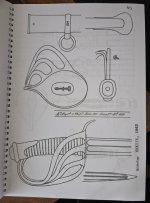
This is the first time I've seen the absence of the ring on the first bail band. That doesn't seem normal to me. Usually, the "German" system at this point is the ring plus the loop along the band. If that's the case, I think it wouldn't be difficult to restore it by having a ring of the correct size welded on, especially since on German knives it's welded, not hinged in a ring.
This sword does not have the AKO 10 january 1895 modification, which consists of removing the lower band when simply set on the scabbard, or cutting the ring and removing the lower ring, to leave only a single attachment.
Kur 2 de la Reine.GIF
Beautiful Pallasch! I have the French cuirassier's M1817 captured at Waterloo, the same model but made by Solingen, and the French carabineer and dragoon's M54, captured in 1870. They are all regimented by the Germans.
Greetings from Lorraine.

 
Nice documentation on these: "Zeitschrift für Heereskunde": 1963.
 

Attachments

  • 20260214_120821.jpg
    20260214_120821.jpg
    494.7 KB · Views: 8
  • 20260214_120734.jpg
    20260214_120734.jpg
    629.1 KB · Views: 8
  • 20260214_120706.jpg
    20260214_120706.jpg
    543.2 KB · Views: 8
  • 20260214_120639.jpg
    20260214_120639.jpg
    623.2 KB · Views: 9
  • 20260214_121042.jpg
    20260214_121042.jpg
    404.3 KB · Views: 10
Hello Peter,
From what I can read on the blade, it's an M1819, described as "Russian Form." The manufacturer's mark isn't written in Cyrillic, but it corresponds to a German manufacturer, most likely from Solingen.
This is the first time I've seen the absence of the ring on the first bail band. That doesn't seem normal to me. Usually, the "German" system at this point is the ring plus the loop along the band. If that's the case, I think it wouldn't be difficult to restore it by having a ring of the correct size welded on, especially since on German knives it's welded, not hinged in a ring.
This sword does not have the AKO 10 january 1895 modification, which consists of removing the lower band when simply set on the scabbard, or cutting the ring and removing the lower ring, to leave only a single attachment.
View attachment 73504
Beautiful Pallasch! I have the French cuirassier's M1817 captured at Waterloo, the same model but made by Solingen, and the French carabineer and dragoon's M54, captured in 1870. They are all regimented by the Germans.
Greetings from Lorraine.
Dear Thierry,
Thank you very much for your invaluable opinion, as always.
Piotr
 
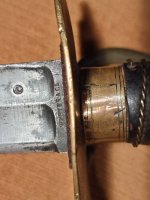
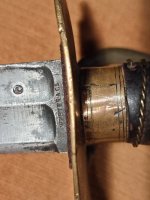
In this photo does anyone know what the circular stamp on the blade is? It looks like a French proof mark. I've got an officer's sword with a scabbard that has the ring on the lower band. Don't see that too often. Are there any Prussian acceptance stamps on the blade or guard?
 

Attachments

  • 163130209_20260212_095438_2150561_resized.jpg
    163130209_20260212_095438_2150561_resized.jpg
    125.5 KB · Views: 8
In this photo does anyone know what the circular stamp on the blade is? It looks like a French proof mark. I've got an officer's sword with a scabbard that has the ring on the lower band. Don't see that too often. Are there any Prussian acceptance stamps on the blade or guard?
Apart from the manufacturer's name on the ricasso, “Wester & Co. Solingen,” and the stamp you mention, there are no other markings on this pallasch.
 
Back
Top