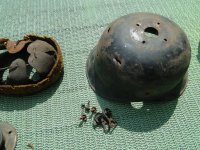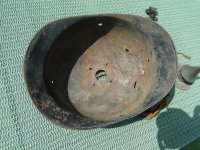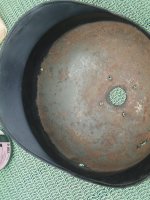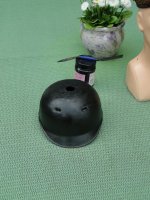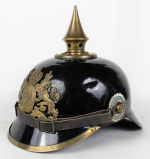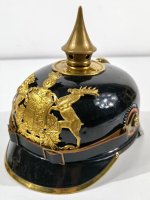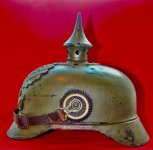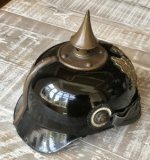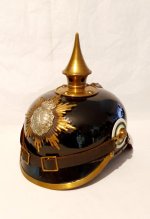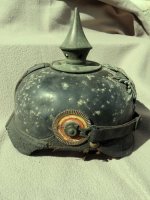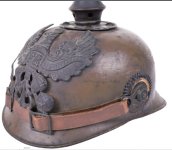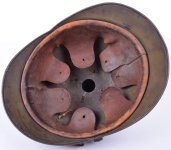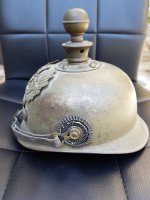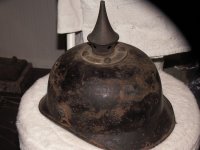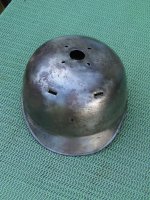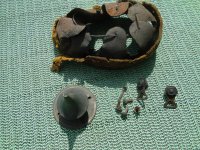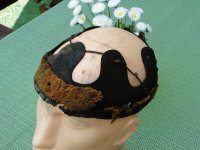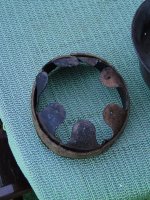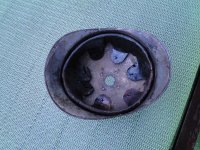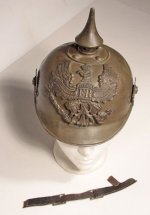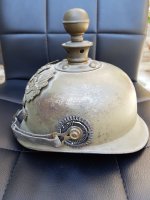
Ersatz model 1895 converted to ersatz 1915

Naprawiacz

Well-known member
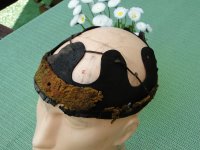
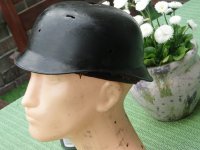
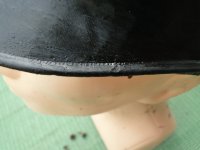
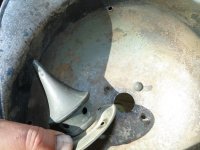
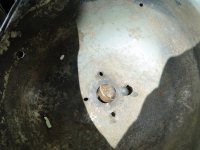
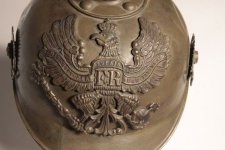
When I saw this helmet on eBay, I decided to have it.The spike and knopfs is made of brass and the rest is made of metal coated with paint.The helmet was originally painted olive green and then repainted black. This is clearly visible on the inside of the helmet, which, due to its original nature, will not be repaired. An interesting feature is the embossing along the entire length of the rim.
 

Attachments

  • DSC07693.JPG
    DSC07693.JPG
    1.2 MB · Views: 28
  • DSC07694.JPG
    DSC07694.JPG
    1.1 MB · Views: 28
  • DSC07695.JPG
    DSC07695.JPG
    1.1 MB · Views: 27
  • DSC07699.JPG
    DSC07699.JPG
    717.8 KB · Views: 29
  • DSC07698.JPG
    DSC07698.JPG
    993.8 KB · Views: 29
  • DSC07697.JPG
    DSC07697.JPG
    534.5 KB · Views: 29
  • DSC07700.JPG
    DSC07700.JPG
    437.5 KB · Views: 29
  • DSC07701.JPG
    DSC07701.JPG
    318.3 KB · Views: 28
This model has the peculiarity of having the 4 rivets fixing the tip in an X shape and not in a + shape as usual.

View attachment 76347
This type of sheet metal helmet is always painted olive green at the factory. Black is not the correct color.
View attachment 76348
Thank you very much, Clovis, for the information. I thought the black varnish was applied in 1915. Now I need to make it olive green.
 
Yes, there are rules regarding the colors black or Feldgrau for sheet metal Pickelhauben.

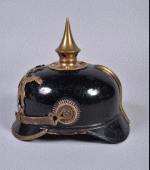
*** Bavarian Bing tanks are always painted black.
Bay BING  (Souvigny).PNG


... Weissenburger, Von der Heyden, Schneller, Baruch, and a few others were painted black.
---Weissenburger or VdH 1 typ M14 brass and black
Rvon der Heyden 1500€EBay22.jpg
Weissenburger-Cannstatt or VdH-Berlin 2 typ M15 Weissenburger and Von der Heyden tanks were initially black, then green after 1915, but black on the firt time.
VdH PHcom JohnS3rd.jpeg---Schneller : sheet steel, aluminum or brass painted black
Laiton laqué noir type Schneller.jpeg
---Hugo Baruch : Schell duralumin, but visor and neck guard in stitched leather
Alu-cuir HBaruch Zébedé.jpg
Alu beige-noir cousu Eparges.jpg


***On the other hand, the "Ersatz" sheets, not stamped under a press, but turned on a ball and forced with a lever, and made from a single piece, like yours, are always painted in khaki (Grüngrau).
Ersatz tôle n96 Baldwin  ~800£.JPGErsatz tôle n96 Baldwin18 Z1-.jpg
Tôle M14Artillerie Verdun16HM17..jpg
This early Ersatz model is easily identifiable by:
---A single sheet metal washer.
---A hemmed edge made of steel wire.
--Striations from the lever used to push the sheet metal onto the mold.
--x-shaped tip attachment here, but the same model exists with a +-shaped attachment.
 

Attachments

  • Weissenburger Wurt Réservist.GIF
    Weissenburger Wurt Réservist.GIF
    46.3 KB · Views: 2
Last edited:
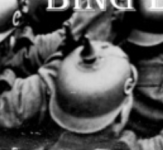
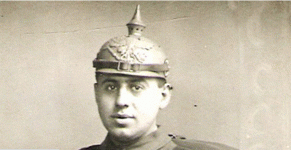
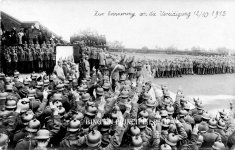
I'm showing this photo because of the absence of helmet covers on the battlefield, due to the khaki color.
Ersatz rivets pte   en X et no en +.jpg
However, the caption is incorrect; the helmets are one-piece Ersatz helmets made of embossed metal with an X-shaped spike attachment (not Bing helmets). Bing helmets have a different shape and lack a liner attachment rivet at the back.
The regiment is not Bavarian; officers would have M86 helmets with square visors, but here the visors are round. The back of this photo refers to Hanover. ( and not Bavarian).
 
Clovis, you've done a tremendous job, and I'm very grateful to you.That old black paint threw me off, but I'm restoring the item to its original condition.
 

Attachments

  • s-l1600.jpg
    s-l1600.jpg
    315.3 KB · Views: 10
  • DSC07702.JPG
    DSC07702.JPG
    998.2 KB · Views: 10
***On the other hand, the "Ersatz" sheets, not stamped under a press, but turned on a ball and forced with a lever, and made from a single piece, like yours, are always painted in khaki (Grüngrau).
View attachment 76361View attachment 76362
View attachment 76363
This early Ersatz model is easily identifiable by:
---A single sheet metal washer.
---A hemmed edge made of steel wire.
--Striations from the lever used to push the sheet metal onto the mold.
--x-shaped tip attachment here, but the same model exists with a +-shaped attachment

Hi Thierry,

I'm very interested in the production method you described above where the lever produces these striations. I've have always been curious to know how these helmets were made ever since I first saw and acquired one years ago. I have never heard the production method mentioned or saw a photo of the process before.

You wouldn't happen to be able to provide more information or maybe a photo of the production process if so, that would be wonderful.

Thanks in advance for any additional information you could provide.
MFG John Josef
 
A question for everyone: what color helmet should I choose? Unfortunately, I don't have a female element and colors are not my specialty.
 

Attachments

  • DSC07711.JPG
    DSC07711.JPG
    2.5 MB · Views: 9
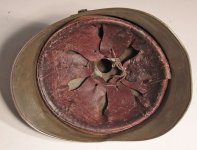
In regard to the manufacturing method that produces the radial lines, it is called spin forming. I worked for a company that purchased steel end caps that were produced using this method. I saw the process. A turning lathe is used to spin a flat steel blank. The motor end of the lathe has a wooden fixture shaped like the finished product. The tail stock end of the lathe has a pressure pad that holds the blank against the wood form. A tool rest perpendicular to the blank has a pivoting long handle with a rounded working end mounted to it that is levered against the blank as it spins. The metal blank is thus formed against the wood form. The steel had a 10% lead content making it malleable. The radial marks are from the tool end and the stretching of the metal as it spins. I suspect our subject helmets required a final process where the visors were integrally formed in a mechanical press and a rim was then rolled.
Ron
 
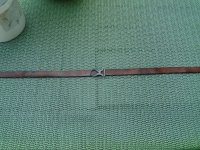
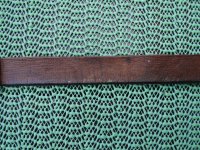
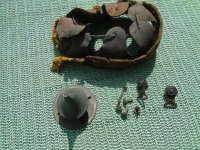
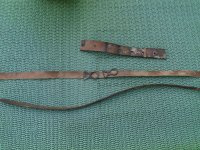
This is my last piece of vintage leather. I made the strap from an old belt from the 1950s. It took me three hours to sand the leather to get the dimensions right.The leather texture is the same as the original.
 

Attachments

  • DSC07712.JPG
    DSC07712.JPG
    3 MB · Views: 11
  • DSC07714.JPG
    DSC07714.JPG
    3 MB · Views: 11
  • DSC07715.JPG
    DSC07715.JPG
    2.4 MB · Views: 11
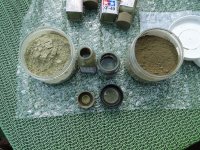
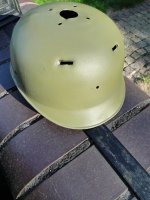
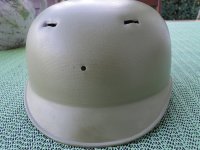
I painted it a dark German greenish umber. The shade is the same as the kugelhaube in the photo above, which Clovis showed. Now I exposed the item to the sun to let the UV rays do their work.Unfortunately, my camera doesn't take good photos.
 

Attachments

  • Tôle M14Artillerie Verdun16HM17..jpg
    Tôle M14Artillerie Verdun16HM17..jpg
    2.1 MB · Views: 13
  • DSC07717.JPG
    DSC07717.JPG
    1.6 MB · Views: 13
  • DSC07716.JPG
    DSC07716.JPG
    1.4 MB · Views: 13
In regard to the manufacturing method that produces the radial lines, it is called spin forming. I worked for a company that purchased steel end caps that were produced using this method. I saw the process. A turning lathe is used to spin a flat steel blank. The motor end of the lathe has a wooden fixture shaped like the finished product. The tail stock end of the lathe has a pressure pad that holds the blank against the wood form. A tool rest perpendicular to the blank has a pivoting long handle with a rounded working end mounted to it that is levered against the blank as it spins. The metal blank is thus formed against the wood form. The steel had a 10% lead content making it malleable. The radial marks are from the tool end and the stretching of the metal as it spins. I suspect our subject helmets required a final process where the visors were integrally formed in a mechanical press and a rim was then rolled.

Ron

Hi Ron,

Thanks for taking the time to post this it's very informative and helpful in understanding and visualizing the process. It brings back the old scool days of wood and metal shop. (y)

Next is to try and find and actual period picture of the process. (y)

MFG John Josef
 
Back
Top