


RoyalScotsVols
Well-known member
The 5th Volunteer Battalion of The Cameronians (Scottish Rifles) had a lineage that stretched from 1862 but they were disbanded rather ingloriously in 1897.
Their history began with the formation of the 4th Administrative Battalion, Lanarkshire Rifle Volunteers on 14 May 1862. This was headquartered in the town of Airdrie and included five corps of Lanark Rifle Volunteers, each of company strength, based in the surrounding towns and each either recruited from the general population or solely from workmen from one of the Iron Works companies in their area.
The battalion grew rapidly in numbers with a further four corps from other towns added in 1865 with three more by 1868. The battalion was now spread over a significant area, headquartered in Airdrie, and included several corps recruited exclusively from workmen from the local iron & steel manufacturers or coal mining companies. Accordingly, it is likely the battalion had a somewhat ‘robust’ personality. During this period, the battalion attended the Royal Review in 1860 in Edinburgh and five large scale training exercises held between 1861 to 1868.
In September 1873 the battalion was consolidated as the 29th Lanark Rifle Volunteers still headquartered in Airdrie and comprising twelve companies although by 1877 numbers had begun to reduce and the establishment of the battalion was reduced to eight companies. Over this period the battalion participated in the Royal Review in 1881 (the infamous ‘Wet Review’ due to the pouring rain) and three regimental and brigade camps. One source credits the battalion, although being one of the smaller units, as having the largest percentage turn out at the Royal Review with HRH Duke of Cambridge having complimented them on their dress and physique. In 1887 they became the 5th Volunteer Battalion, The Cameronians (Scottish Rifles).
Unfortunately, in circa 1895 everything started to go wrong. In common with other rifle volunteer units, the battalion ran a separate shooting club which solely comprised members of the unit. However, a scandal arose over the sale of service ammunition to club members rather than for use for military training. As a result - and in spite of contending that this was common practice in other units - the Commanding Officer was required by the War Office to resign with no suitable replacement being nominated by the battalion. Worse was to follow as the reports written by Col A Lynch of the 26-71 Regimental District following his annual inspections of the battalion in 1895 & 1896 were damning. In 1895 he noted:
‘The men of this Battalion are of good physique. They were very badly turned out on parade, dirty, unsteady, and wanting in discipline; their accoutrements were badly put on, and very dirty. Last year I reported the commanding officer as very good; since last inspection various matters have come under my notice causing me to change my opinion. I consider him quite unfit to command a battalion. The arms of this Battalion I do not consider to be in good order.’
This was followed in 1896 by:
‘The men of this Battalion are of good physique but very badly turned out on parade, dirty and unsteady; the majority of company officers take little or no interest in their companies. The arms of the Battalion are not in good order, being very dirty. I called upon the adjutant for a report on the different companies, which I enclose.’
The officers came in for particular criticism being noted as lacking military knowledge and with three of them (two being company commanders) being publicans who had premises in the towns and villages where their companies were based. They were also alleged to have taken turns to have ‘supplied liquors on the ranges when shooting was on’. This must have done wonders for the shooting accuracy! One officer had been recommended for dismissal but the commanding officer had declined because ‘he provided entertainments for the men’. Sadly, I haven’t found a source to confirm what these ‘entertainments’ were!
The outcome of the above was that the General Officer Commanding in Scotland had recommended to the War Office that ‘I consider it absolutely necessary, in the interests of the Volunteer Forces in Scotland, that this battalion should be disbanded.’
However, the battalion did not go quietly – a public meeting was held in Airdrie attended by the Lord Provost, the local magistrates, Town Council and over 1,000 people where universal sympathy was expressed with the 700 – 800 officers and men of the battalion. Questions were raised in Parliament and a motion was proposed to set-aside the decision of the War Office but this was defeated. Accordingly, the battalion was disbanded on 1 April 1897 – perhaps an appropriate date.
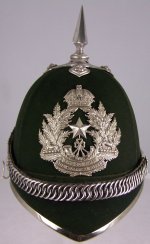
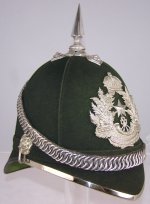
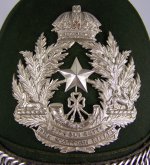
Pictured below is an officer’s helmet from my collection dating from the period 1887 to their disbandment proving that whatever they may have lacked in efficiency, they were certainly well dressed!
As this is a Rifles unit, the helmet is in green cloth and the silver fittings are appropriate for a volunteer officer. The helmet plate is similar to that described in my post for the Cameronians Militia which I will not repeat here but suffice to note the crown is the Guelphic pattern common to rifle regiments.
Their history began with the formation of the 4th Administrative Battalion, Lanarkshire Rifle Volunteers on 14 May 1862. This was headquartered in the town of Airdrie and included five corps of Lanark Rifle Volunteers, each of company strength, based in the surrounding towns and each either recruited from the general population or solely from workmen from one of the Iron Works companies in their area.
The battalion grew rapidly in numbers with a further four corps from other towns added in 1865 with three more by 1868. The battalion was now spread over a significant area, headquartered in Airdrie, and included several corps recruited exclusively from workmen from the local iron & steel manufacturers or coal mining companies. Accordingly, it is likely the battalion had a somewhat ‘robust’ personality. During this period, the battalion attended the Royal Review in 1860 in Edinburgh and five large scale training exercises held between 1861 to 1868.
In September 1873 the battalion was consolidated as the 29th Lanark Rifle Volunteers still headquartered in Airdrie and comprising twelve companies although by 1877 numbers had begun to reduce and the establishment of the battalion was reduced to eight companies. Over this period the battalion participated in the Royal Review in 1881 (the infamous ‘Wet Review’ due to the pouring rain) and three regimental and brigade camps. One source credits the battalion, although being one of the smaller units, as having the largest percentage turn out at the Royal Review with HRH Duke of Cambridge having complimented them on their dress and physique. In 1887 they became the 5th Volunteer Battalion, The Cameronians (Scottish Rifles).
Unfortunately, in circa 1895 everything started to go wrong. In common with other rifle volunteer units, the battalion ran a separate shooting club which solely comprised members of the unit. However, a scandal arose over the sale of service ammunition to club members rather than for use for military training. As a result - and in spite of contending that this was common practice in other units - the Commanding Officer was required by the War Office to resign with no suitable replacement being nominated by the battalion. Worse was to follow as the reports written by Col A Lynch of the 26-71 Regimental District following his annual inspections of the battalion in 1895 & 1896 were damning. In 1895 he noted:
‘The men of this Battalion are of good physique. They were very badly turned out on parade, dirty, unsteady, and wanting in discipline; their accoutrements were badly put on, and very dirty. Last year I reported the commanding officer as very good; since last inspection various matters have come under my notice causing me to change my opinion. I consider him quite unfit to command a battalion. The arms of this Battalion I do not consider to be in good order.’
This was followed in 1896 by:
‘The men of this Battalion are of good physique but very badly turned out on parade, dirty and unsteady; the majority of company officers take little or no interest in their companies. The arms of the Battalion are not in good order, being very dirty. I called upon the adjutant for a report on the different companies, which I enclose.’
The officers came in for particular criticism being noted as lacking military knowledge and with three of them (two being company commanders) being publicans who had premises in the towns and villages where their companies were based. They were also alleged to have taken turns to have ‘supplied liquors on the ranges when shooting was on’. This must have done wonders for the shooting accuracy! One officer had been recommended for dismissal but the commanding officer had declined because ‘he provided entertainments for the men’. Sadly, I haven’t found a source to confirm what these ‘entertainments’ were!
The outcome of the above was that the General Officer Commanding in Scotland had recommended to the War Office that ‘I consider it absolutely necessary, in the interests of the Volunteer Forces in Scotland, that this battalion should be disbanded.’
However, the battalion did not go quietly – a public meeting was held in Airdrie attended by the Lord Provost, the local magistrates, Town Council and over 1,000 people where universal sympathy was expressed with the 700 – 800 officers and men of the battalion. Questions were raised in Parliament and a motion was proposed to set-aside the decision of the War Office but this was defeated. Accordingly, the battalion was disbanded on 1 April 1897 – perhaps an appropriate date.
Pictured below is an officer’s helmet from my collection dating from the period 1887 to their disbandment proving that whatever they may have lacked in efficiency, they were certainly well dressed!
As this is a Rifles unit, the helmet is in green cloth and the silver fittings are appropriate for a volunteer officer. The helmet plate is similar to that described in my post for the Cameronians Militia which I will not repeat here but suffice to note the crown is the Guelphic pattern common to rifle regiments.
Last edited:


