


I recently purchased this helmet from one of our members. I bought it for the metal fittings essentially but upon further thought, it may also provide a "teaching moment" for new collectors. I spent 37 years as a HS History teacher so bear with me....it in the blood!  This helmet has taken a huge amount of environmental abuse:
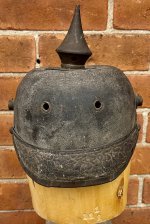
Heavy oxidization on the brass fittings! Once these were a bright brass colour but now.....chocolate brown! Bent tilted spike, blistered finish on the front visors, cracked finish all over the helmet. For new collectors, we are going to explain what has happened to this poor abused piece of History. The blistering and all the finish crazing has been caused by excessive heat. More photos:
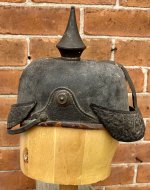
The stitching on both visors... rotted out. The rear spine bent and twisted as the leather shell shrank in the heat. The split pin soldered to the spine naturally broke off as they could not withstand the pressure.
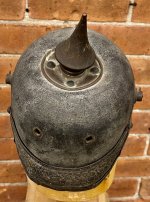
Spike top pushed down into the shell...something heavy put on it (fixable).
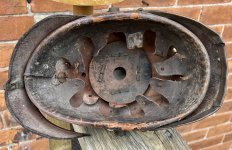
The liner is not too bad....Ratty and Mickey have not chewed on this. However, as usual the brass trim has split in 2 places again, due to shrinkage! We also see the common wear that occurs to the rim of the liner in the areas between the visors. In have seen this countless times and have not explanation....why?
Some comments about shellac finish. A few years ago, Sandy one of our German members tracked down and posted the 1890's "formula" for this finish. Naturally, I thought I could use this in restoration. Consequently, I sourced all of the ingredients on eBay. What amazed me was that all of these were natural, there was nothing from the petro chemical industry, nothing synthetic. Any waterproofing today would have a long list of additives and strange chemicals/preservatives which only a trained chemist could understand...much like our food labels have! Anyway, this helps to explain in my opinion, what we see in this post. Could this piece be restored? Yes, all outside surfaces would have to sanded/smoothed out and the shellac dust from this melted back into the surface using shellac thinner and cotton balls. Visors restitched, shell top wetted and re blocked. It all could be fixed with a great deal of time and effort. We shall see.
This helmet has taken a huge amount of environmental abuse:Heavy oxidization on the brass fittings! Once these were a bright brass colour but now.....chocolate brown! Bent tilted spike, blistered finish on the front visors, cracked finish all over the helmet. For new collectors, we are going to explain what has happened to this poor abused piece of History. The blistering and all the finish crazing has been caused by excessive heat. More photos:
The stitching on both visors... rotted out. The rear spine bent and twisted as the leather shell shrank in the heat. The split pin soldered to the spine naturally broke off as they could not withstand the pressure.
Spike top pushed down into the shell...something heavy put on it (fixable).
The liner is not too bad....Ratty and Mickey have not chewed on this. However, as usual the brass trim has split in 2 places again, due to shrinkage! We also see the common wear that occurs to the rim of the liner in the areas between the visors. In have seen this countless times and have not explanation....why?
Some comments about shellac finish. A few years ago, Sandy one of our German members tracked down and posted the 1890's "formula" for this finish. Naturally, I thought I could use this in restoration. Consequently, I sourced all of the ingredients on eBay. What amazed me was that all of these were natural, there was nothing from the petro chemical industry, nothing synthetic. Any waterproofing today would have a long list of additives and strange chemicals/preservatives which only a trained chemist could understand...much like our food labels have! Anyway, this helps to explain in my opinion, what we see in this post. Could this piece be restored? Yes, all outside surfaces would have to sanded/smoothed out and the shellac dust from this melted back into the surface using shellac thinner and cotton balls. Visors restitched, shell top wetted and re blocked. It all could be fixed with a great deal of time and effort. We shall see.
Last edited:

