Helme für Fähnriche und Fahnenjunker der Kürassiere - Share yours

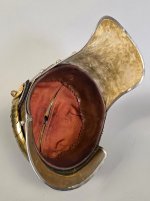
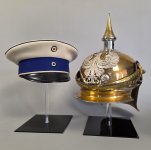
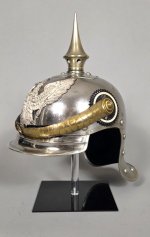
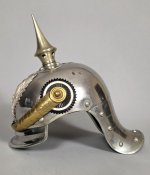
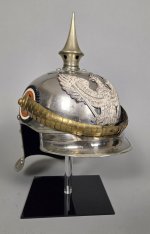
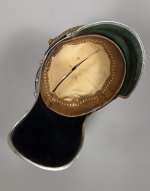
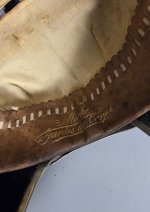
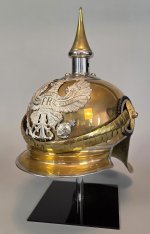
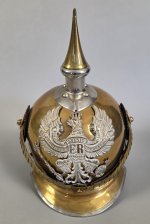
Recently added this handsome fellow, so thought I'd extend the thread. Fahnrich for Kürassier-Regiment Kaiser Nikolas I. von Rußland (Brandenburgisches) Nr.6. The wearer's daddy had deep pockets as it's almost full officer grade, with the exception of the EM -style spike (albeit with a fancy base). The frosty wappen appears to be stamped silver (!). The thin front visor leather has sadly dried and mostly peeled off, but otherwise intact and beautiful. Cream-colored velvet neck lining, with an officer-type liner and sweatband. And paired with an appropriate Schirmmütze for KR6...because I like pairing headgear!
KR6 1.jpg
KR6 2.jpg
KR6 3.jpg
KR6 4.jpg
 
What are the main indicators for a OYV helmet? I have a EMGdC with a taller spike.

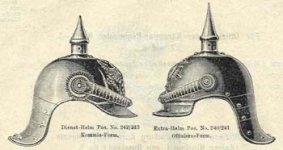
From what I know, after 1889, Kurassier-Kammer helmets for enlisted men had a smooth peak and, most importantly, a simple, rounded visor.
(This is so that the rifle can be shouldered and aimed).

Therefore, the distinction is very simple, as shown in the document below:
Différence Kammer-Off.jpg
---Helmets with these details are enlisted men's helmets. If they have superior quality elements (silk lining, cut-out eagle crown, etc.), they are Eigentum helmets for one- or two-year enlisted men or other "sword-bearers."
---If the helmet has a tall, fluted peak, a quatrefoil base, and a double-stepped, angular visor, it is a Fähnrich or Fahnenjuncker.
A non-commissioned officer's helmet could have many superior features, but the double-stepped, angular visor was forbidden, strictly reserved for officers and Fähnrich or Fahnenjuncker. The same applied to the quadrilobed base of the visor's tip. This was forbidden to the ordinary cuirassier.
 
Last edited:
Back
Top