

RoyalScotsVols
Well-known member
The M33 helmet, designated Elmetto Modello 1933 in Italian, was the standard combat helmet of the Italian forces during the Second World War with the design remaining in use until circa 1992. The Italian army had previously worn the French Adrian helmet from their entry into the First World War in 1915 but by the mid-1920’s this type was no longer seen as satisfactory. Accordingly, the country carried out trials of various prototypes from both Italian and foreign firms but under Mussolini it was probably considered that an Italian design would be the most appropriate.
In 1932 the M31 helmet was adopted but its top mounted ventilation crest was seen as a potential weakness and this was replaced by three ventilation rivets (two on the sides with one on the rear), This alteration formed the M33 helmet which was fully adopted on 29 November 1934. As an aside, Mussolini was always photographed wearing an M31 likely preferring the profile of the comb top.
The M33 was first used by the Italians during the Ethiopian War in 1935 and was also used by the Italian force sent to assist General Franco in the Spanish Civil War in 1936. The Spanish army continued to use the helmets left by the Italians until the late 1970’s. This style of helmet remained in use with a number of armies around the world after 1945 although there were several design changes which make it possible to identify a helmet made prior to or during the Second World War.
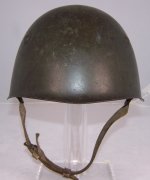
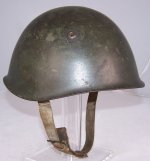
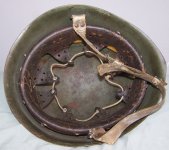
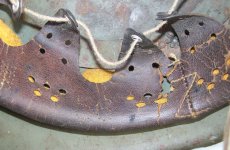
I believe the helmet pictured below is an example of an Italian M33 from the WW2 period but other opinions are welcome. Its size ‘56’ is stamped into the leather liner by a series of dot holes (which can hopefully be made out in the photo below). Whilst there are various colour variations of Italian army helmets, this example appears quite common in having been originally painted semi-gloss sage green which was correct for the period 1934 to June 1940 but then overpainted externally in a matt slightly darker green. The original paint can be seen internally and where the overpainting has worn externally, but this may not show up too well in the photos.
In 1932 the M31 helmet was adopted but its top mounted ventilation crest was seen as a potential weakness and this was replaced by three ventilation rivets (two on the sides with one on the rear), This alteration formed the M33 helmet which was fully adopted on 29 November 1934. As an aside, Mussolini was always photographed wearing an M31 likely preferring the profile of the comb top.
The M33 was first used by the Italians during the Ethiopian War in 1935 and was also used by the Italian force sent to assist General Franco in the Spanish Civil War in 1936. The Spanish army continued to use the helmets left by the Italians until the late 1970’s. This style of helmet remained in use with a number of armies around the world after 1945 although there were several design changes which make it possible to identify a helmet made prior to or during the Second World War.
I believe the helmet pictured below is an example of an Italian M33 from the WW2 period but other opinions are welcome. Its size ‘56’ is stamped into the leather liner by a series of dot holes (which can hopefully be made out in the photo below). Whilst there are various colour variations of Italian army helmets, this example appears quite common in having been originally painted semi-gloss sage green which was correct for the period 1934 to June 1940 but then overpainted externally in a matt slightly darker green. The original paint can be seen internally and where the overpainting has worn externally, but this may not show up too well in the photos.
