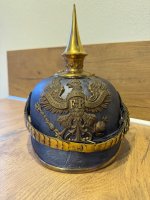
Prussian 1895 officer's Pickelhaube

SvenK

New member
Hi everyone,

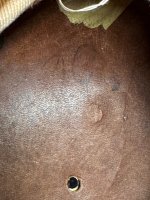
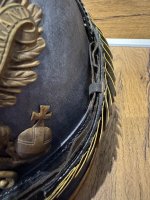
I acquired this Prussian officer's Pickelhaube (model 1895). The surface has a bluish tint and is still relatively smooth; it appears to have been given a coat of shellac.

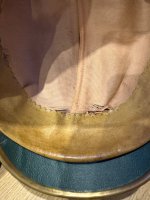
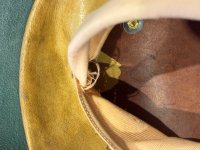
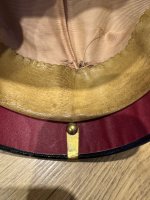
Unfortunately, the writing on the inside is no longer legible. Or can you make anything out?

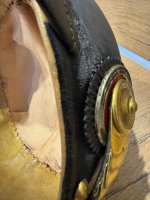
I find it surprising that the vulcanized fiber extends slightly beyond the metal base plate. However, this has the advantage that the helmet body has remained extremely sturdy. Have you ever seen anything like this?

Thanks, Sven
 

Attachments

  • IMG_3476.jpg
    IMG_3476.jpg
    153.7 KB · Views: 18
  • IMG_3466.jpg
    IMG_3466.jpg
    170.6 KB · Views: 18
  • IMG_3480.jpg
    IMG_3480.jpg
    185.4 KB · Views: 18
  • IMG_3479.jpg
    IMG_3479.jpg
    178.1 KB · Views: 18
  • IMG_3470.jpg
    IMG_3470.jpg
    194.5 KB · Views: 20
  • IMG_3469.jpg
    IMG_3469.jpg
    162.2 KB · Views: 20
  • IMG_3481.jpg
    IMG_3481.jpg
    200.2 KB · Views: 20
  • IMG_3474.jpg
    IMG_3474.jpg
    165.4 KB · Views: 18
Hi Sven,

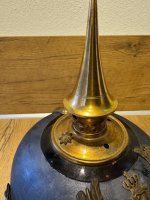
The round black metal plate that is located below the spike base should be located on the inside of the helmet body to support the spike as originally intended and act as a washer for the star stud retaining nuts. For some reason, we find many helmets assembled incorrectly as this. My theory is that these helmets were assembled post war by allied troops to be sent back as war bond helmets or that allied soldiers removed the spike when bringing or shipping the helmet home as a souvineer.

I think your helmet body is leather rather than fiber (vulcanized) but the front visor may be fiber, based on your photos; I’m not sure. If it were mine, I would relocate the plate and look for a couple missing star studs to fasten the spike to the body. If the plate has been in this position for an extended time, there may be a witness mark or indentation left on the body that will show when the plate is relocated. It then becomes a choice where you wish to locate the plate.

As far as the blue tint to the finish, that is unusual. If you believe that it has been re-shellaced, you have the choice to leave as is or re finish. That would require the blue shellac to be removed with solvent or sanded off and new gloss black shellac to be applied. This is labor intensive and difficult to do correctly. If you are interested, search the forum for related topics.

Other than this, the helmet looks great and you should be congratulated on acquiring it!

Ron
 
Back
Top