Recently found Tombac Kurassier e.m. helmet C.E. Junker 1914 missing wappen

ww1czechlegion

Well-known member
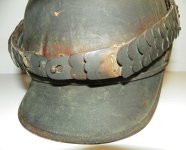
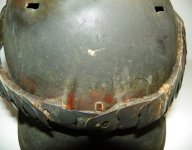
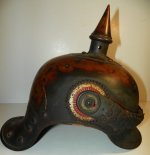
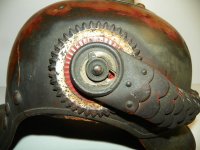
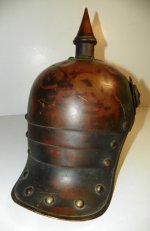
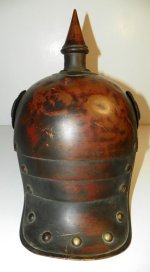
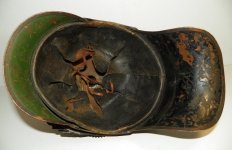
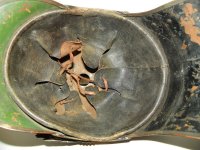
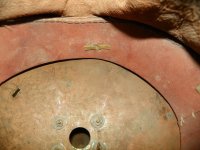
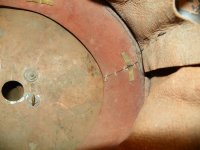
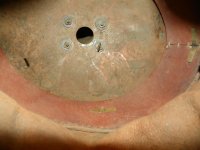
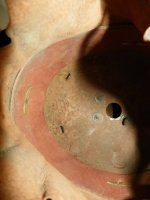
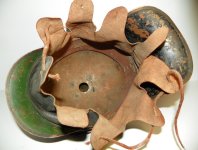
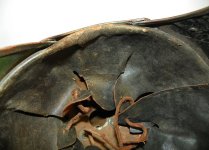
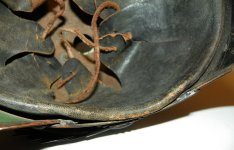
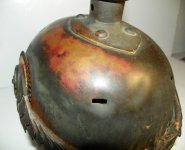
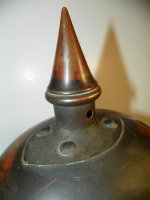
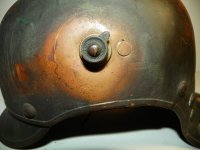
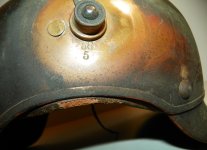
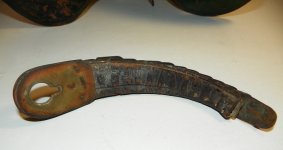
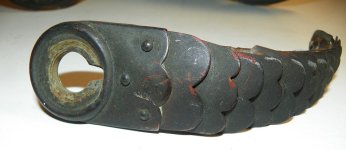
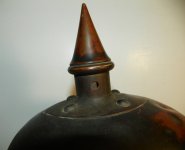
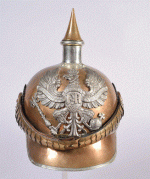
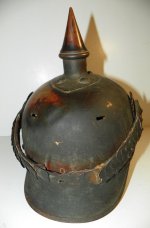
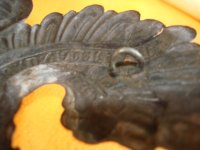
Recently found Tombac kurassier helmet, maker marked "C.E. Junker 1914." Size "58.5" on the underside of the back visor trim, and on the wearer's right side below the side post mount for the chinscale attachment.

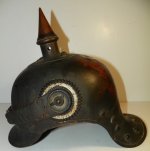
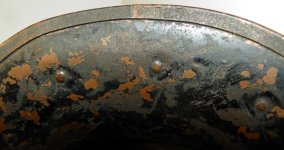
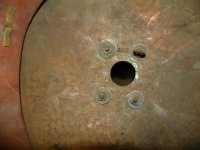
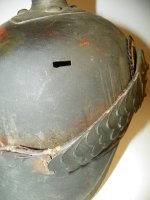
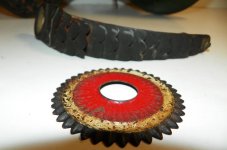
"12" marked in center front of helmet, which would be hidden by a wappen. Seen in the 3rd photo posted below.

There are No regimental issue markings on this helmet. Could it be 6th Kurassier Regiment? Or Garde Kurassier/Garde du Korps?

No wappen came with the helmet.

The inner measurement distance for the wappen holes is 74 or 75mm distance.

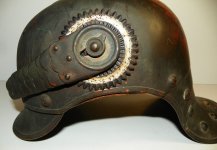
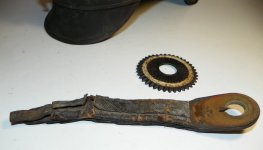
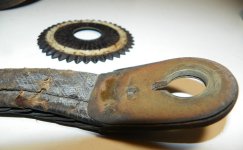
Wearer's left side chinscale is missing the 4th & 5th segment near the connection end, as seen in photos. Chinscales are tombac.

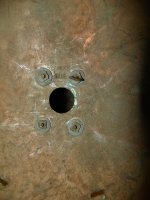
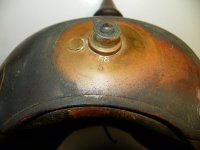
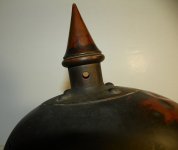
Spike is the style that slips into the neck of the spike base and turns to open/close the ventilator holes. Last photo posted will show the vent hole partially closed.

Lastly, I would like to hear any thoughts on what to use to clean the dark patina on this helmet. Or should I leave it as is, heavily tarnished with a "black" patina.

I look forward to your thoughts and comments.

Thanks,

Alan


101_0060.JPG

101_0061.JPG

101_0062.JPG

101_0065.JPG

101_0066.JPG

101_0067.JPG

101_0068.JPG

101_0069.JPG

101_0070.JPG

101_0071.JPG
 
Thanks, Rob! Right now it's still a new "toy", and I'm not sure if I will end up keeping it or reselling it.

To clean, or not to clean, that is the dilemma.

The person I bought it from claims it sat in his neighbor's basement for a very long time. Who knows if the story is true or not?

Best Wishes,

Alan
 
Congrats Alan! You are truly the Indiana Jones of the Pickelhaube World. The number of “finds” you come up with is awesome. Unusual to see a 58.5 size with a complete interior in contrast to the heavily tarnished exterior. Personally, I would clean it and restore it to its original glory.
And so would I Brian!
Its a great helmet, and it would look great, all cleaned up. In fact, I for sure would have wanted that one in my collection too.
My only Kurassier helmet is an M15, nice too, by the way! A very nice one Alan!

Regards, Coert.
 
Wonderful find Alan! You are the king! I agree with Brian on restoring it. I am a strong believer in keeping original patina, but this one has multiple places where the patina is not consistent (cleaning/rubbing). Longer term patina presence may lead to pitting in the tombac and brass.

Due to the severity of the patina, to restore it will require wet sanding the parts with progressively finer grit paper, starting with 400 grit and finishing with 1000. Then a polish job using a buffer or by hand with Flitz, Semi-Chrome, or similar polish. The chinscales are the most difficult. You have to protect the leather during the process of cleaning and polishing each scale. I estimate it will take over 12 hours to do the job right. When you are finished, your finger nails will not need trimming for a month. Chemical cleaners may remove some of the oxidation, but it will take less time by just sanding from the start. I have restored 2 tombac helmets and I am happy with the results.

A couple interesting observations of your helmet: one of the four nuts retaining the spike base is an early loop top nut; just above the missing chin scale you mention are 4 two-lobe scales (typically alternating 2-3-2-3 etc pattern). These have obviously been that way a long time. In regard to front wappen, I suspect this to be 6th Kuirassier. I didn’t take time to measure any of mine, but I think GDK/GKR holes would be closer together?

Ron
 
Great find Alan Congratulations I'm always happy to see items out of the wild in their natural state. (y)(y)

I'm sure whatever you choose to do with it will look great.

MFG John Josef
 
Hello Alan,
A very fine KR6 helmet as it was when it went into action. Well done!!!
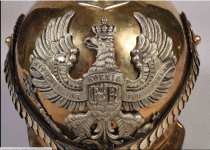
The position of the two rectangular holes causes the guard to splay out. They are too far apart and too high up. So a Prussian line eagle, made of nickel silver, is indeed what is required. According to regulations, an M1860 (4 November) design is required, but during mobilisation, shortages led to the use of infantry eagles; a similar one, such as a ‘Pionnier’ eagle here, would be suitable as ‘Kriegsfertigung’.
As for cleaning, personally I would restore it to its original condition, that is to say, so that it regains its authentic visual appearance, rather than being ‘altered’ as it is here.
In this specific case:
---I do not touch the interior.
---I carefully unscrew the tip.
I rub it with 0000 steel wool, which is softer than 800-grit car body sandpaper. Take particular care with the rivets not to create ‘facets’ like a diamond!
The grimy oxidation on this helmet has nothing to do with the authenticity of the heroic charges of 1914.
It is merely evidence of the damp conditions in a cellar, or of prolonged exposure to damp in an attic, which has preserved the inside of the shell.
Furthermore, as mentioned above, even on so-called ‘stainless’ metals, over time oxidation slowly causes the metal to deteriorate.
If cleaned, it will initially look shiny and gleaming, but after a few months, a slight patina will return.

Here is the M60 eagle, which was used by the cuirassiers until 1914. With its openwork crown, this is an officer’s eagle; the one used by the troops is identical but has a solid crown.
Kur 0ff Soissons20.GIF

For your information, here is a specific bridge for the front plates of cuirassier helmets (Garde-Stern and Kurassier-Adler)
KurAdler pontet spécial.jpg
KR6 Troupe.GIF
 
Back
Top