Stumbled on a gold mine??

Tip

New member
I am not a collector, but the internet implies that all you fine people are the most knowledgeable resource I have access to.

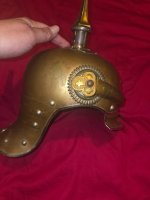
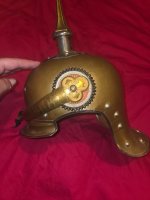
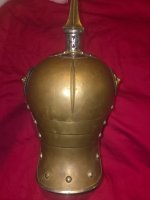
My husband found this helmet buried in a box of antique Christmas ornaments. All of the googling I've done has mostly led me here or Kaisers Bunker. I've read a lot and I believe this is a WWI Officer's picklehaube. But, in every picture I see, the metal colors seem to be reversed. Maybe that's just patina. ;)

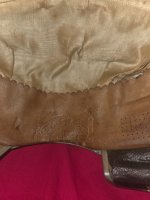
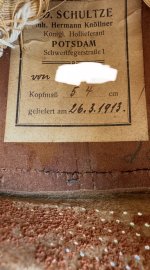
What I've gathered is that this is an officers helmet from Saxony (green and white cockade). Also, the leather imprint says Mars Patent, DRP 215452 L.

Any help and information would be greatly appreciated. Maybe someone will get excited to see my treasure and know a lot about it. If that person exists, I'm sure they'd be right here!

Thank you in advance.
 

Attachments

  • 20260730_205330.jpg
    20260730_205330.jpg
    827.8 KB · Views: 43
  • 20260730_205240.jpg
    20260730_205240.jpg
    2 MB · Views: 42
  • 20260730_205227.jpg
    20260730_205227.jpg
    1.1 MB · Views: 45
  • 20260730_205218.jpg
    20260730_205218.jpg
    1.1 MB · Views: 45
  • 20260730_205210.jpg
    20260730_205210.jpg
    1.1 MB · Views: 45
  • 20260730_205157.jpg
    20260730_205157.jpg
    981.2 KB · Views: 43
  • 20260730_205148.jpg
    20260730_205148.jpg
    1,016.5 KB · Views: 43
Hello Tip, and welcome to the forum.

Congratulations on a nice find.

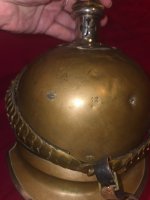
It does indeed look like this is an original Saxon Garde Reiter Officer Helmet.

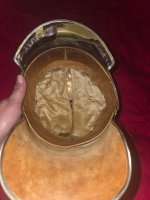
Unfortunately, it's a real shame that the front emblem has broken off from the helmet. It looks like the two attachment screw posts are still intact in the helmet emblem or "wappen" attachment holes. Could you gently part the cloth headliner, and look to see if there are two threaded screw posts inside of the wearer's forehead area of the helmet, with a nut on each screw post?

A couple of other odd things about this helmet:
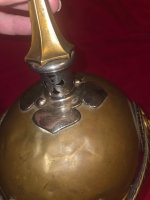
1.) At some point of time, someone took the spike base off form the helmet and turned it a quarter turn. It also looks like there is a domed brad head that broke off a screw post on the cloverleaf shaped spike base.
2.) Someone also took the chinscales off from this helmet, and swapped sides with the two decorative disks on the right and left side of the helmet. These "Kokarde" appear to be original, as do the kleeblaten (cloverleaf shaped gilt brass device) directly underneath the large flat slot screw post on both sides of the helmet.

I would simply leave the helmet the way it is, and don't try to change any parts around on it.

One important tip about your helmet: Touching the metal parts with your bare hands on this metal helmet will leave fingerprints. Every human has a slight acidity to their fingerprint and when bare hands touch the surface of the helmet body and the spike, it will eventually turn into an acid etching into the metal in the shape of a fingerprint. Simply wipe the fingerprints off with a dry clean cloth.

Thanks for posting your nice helmet find here.

Best Wishes,

Alan
 
Last edited:
The colors are correct for this helmet. They are not reversed. A Saxon Garde Reiter helmet has this tombac color metal body. The top of the spike is the correct tombac color. The neck of the spike and the cloverleaf shaped spike base, and the domed brads, and the rivet brads and edge trim on the helmet are all the correct white metal color.
 
You do indeed have a very nice helmet the parts missing, while difficult to find shouldn't be impossible. I think I have seen the appropriate wappen for sale somewhere recently, I'll check and see if i can find one if you're interested in restoring it yourself.
 
Thank you everyone for your kindness and good news!! I wonder if anyone can help me figure out what year this might be? I gathered from kaisers bunker that the chinstrap attachments are pre 1895, but sometimes the wording is confusing to me. Also, I was curious about the "42" under where the wappen would be.

Thank you to Alan for all of the great info! It really is a shame the wappen is missing. Such a beautiful one! And the parade lion?!? BEAUTIFUL!!
 
Thank you everyone for your kindness and good news!! I wonder if anyone can help me figure out what year this might be? I gathered from kaisers bunker that the chinstrap attachments are pre 1895, but sometimes the wording is confusing to me. Also, I was curious about the "42" under where the wappen would be.

Thank you to Alan for all of the great info! It really is a shame the wappen is missing. Such a beautiful one! And the parade lion?!? BEAUTIFUL!!


Your helmet was likely made pre-WW1, before 1914. Maybe around 1910, or possibly earlier. It could have been made in the late 1890's. It is hard to pinpoint an exact year of manufacture for it.

The "42" mark is a manufacturer's part identification number. We often see these various number markings on the metal pickelhaube/spike helmets. Sometimes we see the front emblem for these helmets having a matching number marked on the back side of the emblem. Since the front emblem is missing on your helmet, we'll unfortunately never know if it was marked or not.

The chinstrap attachment method found on your helmet was used from the 1890's up into WW1 time period, when this officer helmet configured as it is, could have been worn.

I believe you are confused by what you saw on Tony's excellent website. I believe you are referring to the chinstrap attachment for an enlisted man's style of Cuirassier type of helmet, which is a different type of helmet body as compared to what your helmet is. The enlisted version helmet had the chinstrap or pair of chinscales attached by a model 1891 style side post, on the right and left side of an enlisted man's helmet. Since your helmet is an officer helmet, the chinscales are attached by a large knurled edge, domed flat head screw. Officer helmets used this different style of chinstrap or chinscale set attachment, compared to how enlisted men's helmets attached the chinscales/chinstraps to their helmets. I hope this clarifies things for you with your question/statement.

Best Wishes,

Alan
 
Last edited:
Hello,
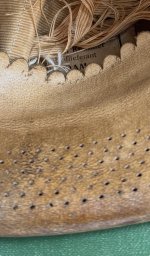
I think that this helmet could have been produced shortly after end of the war or in the 20ties for official vets ceremonies. Why? Because of this typical liner with small holes at the front.
Philippe
 
Back
Top