

You are using an out of date browser. It may not display this or other websites correctly.
You should upgrade or use an alternative browser.
You should upgrade or use an alternative browser.
The Forgotten Faschinenmesser
- Thread starter Larmo
- Start date


Some parasite spammer bumped this thread up from the last posting in 2018. I have deleted the spammer pustule but this is such an extensive, detailed, and interesting examination of the Faschinenmesser that I am just making a quick posting to keep it bumped up for those that have not seen it. Really an excellent presentation by Larmo well worth reading. =D>

Nacuaa
Well-known member

CLOVIS 57
Well-known member
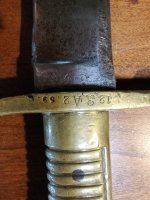
Yes. -Hello, Can anyone identify the mark P D... on the blade of this Faschinenmesser? 2nd.Leibhusar identified the hilt stamping as 12 Reserve Feldartillerie-Regiment. I don't see any other markings... Crown, FWR etc. Thank you!
These are the initials of Peter Daniels - Solingen.
The factory's history began when a German scissor-maker from Solingen, Peter Daniels Pauls, married Johanne Amalie Storsbeg, whose father owned a successful cutlery business. In 1834, shortly after the wedding, Paul began producing penknives himself. Paul's first shipment of knives went to the USA in 1850, and his high-quality knives were appreciated by both dealers and collectors. Peter and Johanne's daughter would later marry a young scissor maker named Frederich Robert Klaas, and after Paul's death, the two companies merged to form the Robert Klaas Company in 1869. Production increased and the Klaas name continued to gain popularity, and in 1895 Klaas registered the “Kissing Crane” logo as his trademark.
Translated with DeepL.com (free version)
-
Last edited:

I agree, so to keep it going correctly, those markings on that Saxon faschinenmesser in post #45 are clearly P.D.L., the very well known prolific Peter Daniel Lüneschloss of Solingen, known in the US for manufacturing the Tiffany M1840 wrist breaker among other civil war blade imports.
Like most German states Saxon artillery pieces were marked accordingly, but after unification they received Prussian style markings, with the 12th regiment (1st royal Saxon) being the most commonly found.
Like most German states Saxon artillery pieces were marked accordingly, but after unification they received Prussian style markings, with the 12th regiment (1st royal Saxon) being the most commonly found.
three60mafia
New member
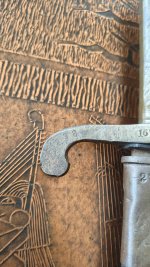
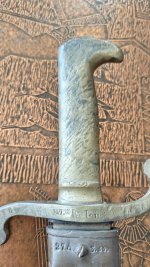
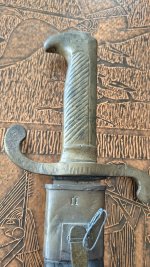
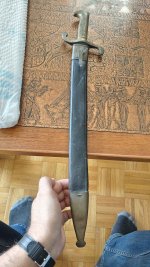
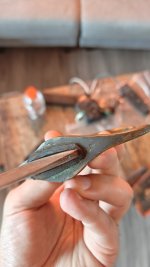
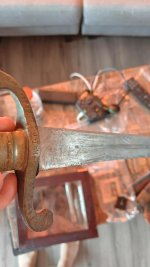
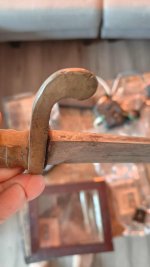
Hi there. Recently came into posession of this sword, and reverse image search brought me to this amazingly helfpful thread. My late grandfather had this sword in his posessions but he never talked to anyone about it, not even his closest family like brother. So we have no history of it at all.
I'm attaching as many photos as I can. Any identification information would be amazing, it clearly fits into this family of swords somehow, but it doesnt have any blade markings at all like crowns.
I tried using an online service (mearto) to identify it but I think they used AI or something because what they wrote doesn't seem at all accurate. Except for maybe unit markings? I dont think the yataghan part is accurate at all.
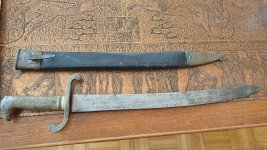
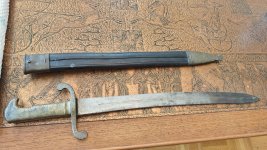
I'm attaching as many photos as I can. Any identification information would be amazing, it clearly fits into this family of swords somehow, but it doesnt have any blade markings at all like crowns.
I tried using an online service (mearto) to identify it but I think they used AI or something because what they wrote doesn't seem at all accurate. Except for maybe unit markings? I dont think the yataghan part is accurate at all.
...this is actually a French Model 1866 Chassepot yataghan-style bayonet (known as the “baïonnette modèle 1866”). There are a few identifying characteristics to confirm this:
The bird-head / beak pommel is iconic for the Chassepot bayonet family; it has a German-style ribbed brass grip that French 1866 bayonets used with longitudinal ribs identical to yours. The quillon crossguard has a forward curl, some which were later shortened or bent inward in service and it has a press-stud lock above the guard, which was used to mount this to a rifle. Additionally, it appears to retain its original scabbard (leather-over wood) with brass throat and chape
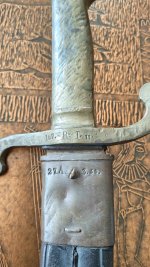
The marks on the crossguard are unit (regimental) markings and the rack / inventory numbers on the scabbard throat. These stamps are textbook examples of late-19th-century Germanic-style unit marking practice. Even though your bayonet is French in origin (Model 1866 Chassepot), huge numbers were captured in 1870–71 during the Franco-Prussian War and then adopted into German service, at which point they received German unit stamps like this.
The crossguard markings "167. R. T. 1. 2" can be translated as "167. R. = 167th Infantry Regiment (R = Regiment); T. = Truppenteil (sub-unit), or sometimes Train (support element); 1. = company number; 2 = weapon number / rack number within that company" In short, this was the Weapon #2 of 1st Company, 167th Infantry Regiment (
To read the scabbard throat marking "27. A. 3.50"
This is a later re-issue — scabbards and bayonets were often reassigned to different units and likely reads as "27. A. = 27th Artillery Regiment; 3. = 3rd Battery; 50 = weapon / rack number"... this means that later in its service life this Chassepot bayonet served with German artillery units. It is very common to see multiple sets of unit marks on bayonets that saw decades of service because during the Franco-Prussian War (1870–1871) Germany captured hundreds of thousands of French M1866 bayonets — so many that they were officially adopted for reserve units, fortress troops and artillery.
The little tiny numbers/letters on the pommel (dots, stars, inspector letters, etc) are French proof and acceptance marks, usually from the manufacture arsenal. The German army then stamped unit marks onto them to integrate them into inventories.
On the blade spine (when drawn), there is usually an arsenal inscription such as "Mre d’Armes de Châtellerault", "Mre de St. Étienne," "Mre de Tulle," and "Mre de Klingenthal"…and a manufacture year...
Attachments
-
 IMG20251025112542.jpg558.8 KB · Views: 16
 -
 IMG20251025112548.jpg585.3 KB · Views: 14
 -
 IMG20251025112617.jpg597.8 KB · Views: 9
 -
 IMG20251025112624.jpg715.4 KB · Views: 9
 -
 IMG20251025112637.jpg822.1 KB · Views: 8
 -
 c167b987-587d-4e6c-aa0c-db260451b610.jpg614.8 KB · Views: 8
 -
 bb547659-4861-4eaf-b9ca-f9fb6c8be808.jpg80 KB · Views: 7
 -
 c4c5fa36-a12b-4c3a-9d17-b31ae2c7e351.jpg64.1 KB · Views: 8