

RoyalScotsVols
Well-known member
The Royal Scots, the 1st Regiment of Foot and holders of the coveted position at the right of the line were the oldest regiment in the British Army and the senior regiment of infantry. They were formed in 1633 when Sir John Hepburn, under a Royal Warrant granted by King Charles I, raised recruits in Scotland based upon a nucleus of men who had served in various other ancient and historic regiments. These earlier regiments were so old that their origins are obscure and so the Royal Scots can claim an ancestry of considerable antiquity – accordingly the regiment has the tongue-in-cheek nickname of ‘Pontius Pilate’s Bodyguard’. The regiments main recruiting areas became Edinburgh, the Lothians and Tweedale with the regimental headquarters situated in Edinburgh Castle.
The full list and description of the campaigns the regiment has undertaken would be too long to realistically include in this brief description. However, it is worthwhile to note that the regiment has been awarded a total of 149 Battle Honours reflecting the regiment's service worldwide since its formation. 'Battle Honours' are the official recognition awarded to regiments of the British Army in respect of particular service, either in a campaign or a significant battle. They are typically displayed on the units colours, flags or other insignia and serve as a visible reminder of the unit's history and achievements. The Royal Scots first Battle Honour was ‘Tangier 1680’ with ‘Gulf 1991’ being the last. Perhaps the most unusual is ‘Archangel 1918 – 1919’ when the regiment, after extensive service in the First World War, was sent to Russia to fight the Bolsheviks. This expedition is not well known and was undertaken against a backdrop of great trials and hardships at a time when Europe was exhausted by war and the old Russian Empire had collapsed.
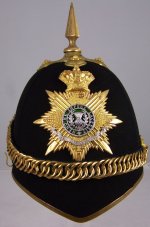
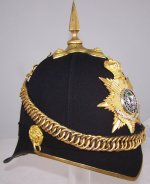
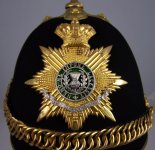
Pictured below is a regular officer’s home service pattern helmet of the style worn from 1891 to the death of Queen Victoria in 1901 after which the crown changed to that for King Edward VII. The helmet fittings are in gilt and the plate carries the Star of the Order of the Thistle and the cross of St Andrew with a silver thistle within a circle pierced with the regimental moto ‘Nemo Me Impune Lacessit’ (No-one provokes me with impunity) on a green enamel background. The regiments name ‘The Royal Scots’ is in silver on a separate scroll.
The full list and description of the campaigns the regiment has undertaken would be too long to realistically include in this brief description. However, it is worthwhile to note that the regiment has been awarded a total of 149 Battle Honours reflecting the regiment's service worldwide since its formation. 'Battle Honours' are the official recognition awarded to regiments of the British Army in respect of particular service, either in a campaign or a significant battle. They are typically displayed on the units colours, flags or other insignia and serve as a visible reminder of the unit's history and achievements. The Royal Scots first Battle Honour was ‘Tangier 1680’ with ‘Gulf 1991’ being the last. Perhaps the most unusual is ‘Archangel 1918 – 1919’ when the regiment, after extensive service in the First World War, was sent to Russia to fight the Bolsheviks. This expedition is not well known and was undertaken against a backdrop of great trials and hardships at a time when Europe was exhausted by war and the old Russian Empire had collapsed.
Pictured below is a regular officer’s home service pattern helmet of the style worn from 1891 to the death of Queen Victoria in 1901 after which the crown changed to that for King Edward VII. The helmet fittings are in gilt and the plate carries the Star of the Order of the Thistle and the cross of St Andrew with a silver thistle within a circle pierced with the regimental moto ‘Nemo Me Impune Lacessit’ (No-one provokes me with impunity) on a green enamel background. The regiments name ‘The Royal Scots’ is in silver on a separate scroll.
Last edited:

 Thanks for the history I really enjoyed that as well.