
You are using an out of date browser. It may not display this or other websites correctly.
You should upgrade or use an alternative browser.
You should upgrade or use an alternative browser.
Something about the Grand Duchy of Oldenburg
- Thread starter Zebedeus
- Start date
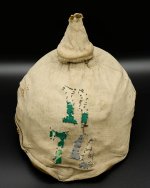
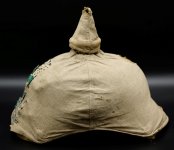
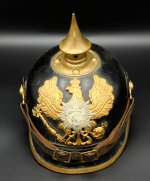
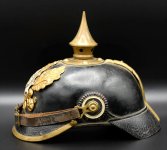
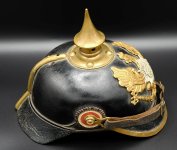
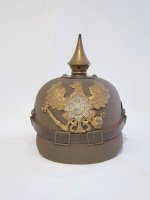
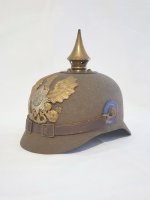
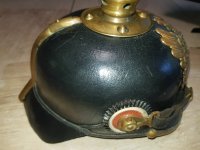
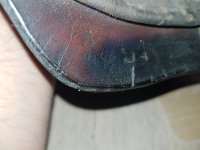
This Ueberzug is a little battered but the R74 front numbering remains clearly legible. Inside, both the cover and helmet bear the same markings: JR74 and R.J.R.74.2.B. The same name, Heine, also appears on both the Ueberzug and rear flap of the Pickelhaube. A perfect match.
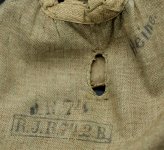
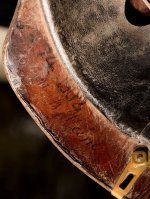
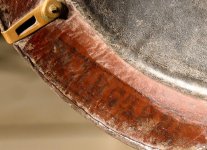
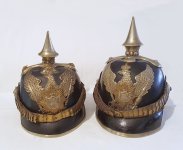
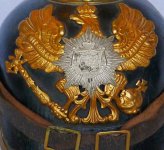
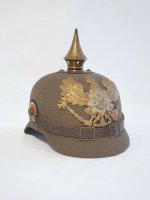
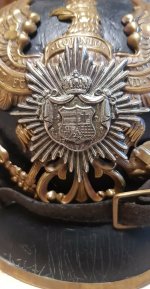
You may wonder why I added this 74th to a thread dedicated by Zeb to the 91th. The answer comes when you strip the helmet from the Ueberzug, revealing an Oldenburg eagle plate. It happens that a JR91 reserve unit was with RJR74 (assumably in 1B, not 2B though). The eagle bears a scroll and no reserve cross and cockades are the regular Prussian set. The helmet is perfectly homogenous; the plate fits snugly and has been obviously sitting there for ages. I should add that I got it - a war trophy - from a family in Central France and that it is extremely unlikely that it was ever messed with after the war. Then, why this bizarre combo? Was soldier Heine nostalgic of his active affectation, and wanted to keep this souvenir of his time with JR91, if he ever was? Was it accepted to keep a different, non-regulation plate, as long as it was hidden by the cover (I know rules were sometimes loosely adhered to in the reserve, Landwehr...)? I have no clue, and would welcome suggestions from forum experts.

Zebedeus
Well-known member
Dear Bruno, you've shown a beautiful helmet, undoubtedly untouched, with its matching shroud perfectly matching the markings and the name of its former owner.You may wonder why I added this 74th to a thread dedicated by Zeb to the 91th. The answer comes when you strip the helmet from the Ueberzug, revealing an Oldenburg eagle plate. It happens that a JR91 reserve unit was with RJR74 (assumably in 1B, not 2B though). The eagle bears a scroll and no reserve cross and cockades are the regular Prussian set. The helmet is perfectly homogenous; the plate fits snugly and has been obviously sitting there for ages. I should add that I got it - a war trophy - from a family in Central France and that it is extremely unlikely that it was ever messed with after the war. Then, why this bizarre combo? Was soldier Heine nostalgic of his active affectation, and wanted to keep this souvenir of his time with JR91, if he ever was? Was it accepted to keep a different, non-regulation plate, as long as it was hidden by the cover (I know rules were sometimes loosely adhered to in the reserve, Landwehr...)? I have no clue, and would welcome suggestions from forum experts.
View attachment 63690View attachment 63691View attachment 63692View attachment 63693
A remarkable set that everyone would want in their collection.
Unfortunately, I don't have a precise answer to your question, but I believe that, as you've already written, the regulations, however precise, were often disregarded. This was especially true for second-line units, such as the Landwehr and the reserve.
We all know that these units were equipped with surplus stock and whatever was available at the time.
Several photos from the period show uniform inconsistencies, with groups of soldiers wearing helmets with different insignia, feldzeichen, or buckles that are inconsistent or otherwise different.
So the regulations are one thing, and the practical situations experienced at the time are another.
Even for me, the presence of the cover with the correct number of the unit could have overshadowed the fact of a plaque that was not specific to the same unit and that for contingent reasons or those desired by the former owner, the soldier continued to wear an I.R.91 helmet.
festwagner
Active member
A exceptionnal set pickelhaube/Uberzug ! As OJR 91 raised I/RJR 74, there is a logical connection between the two units. I would say a lack of plates which needs to take what was avalaible. The stores asked help and received what was available.
Zebedeus
Well-known member
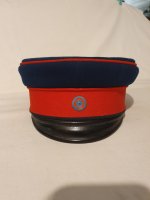
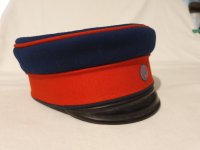
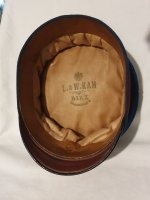
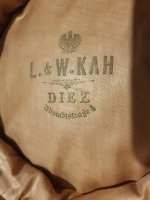
I couldn't resist buying this Mod. 1867 visor cap from the Oldenburg 91th infantery rgt. I find it so fascinating. And what condition it still is after more than 150 years.
Attachments


gino1
Well-known member
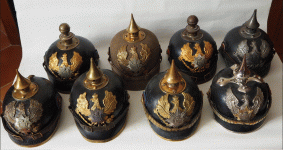
Alleen deze voorstellen uit mijn bescheiden collectie
Attachments
-
 75abeb40-417c-42df-b50f-2ecdd616ece6.jpg351.5 KB · Views: 10
 -
 39053167-fc86-4d33-bdab-a2066f3a44f6.jpg359.2 KB · Views: 10
 -
 100e60c1-4610-4bd6-985b-a051768dac10.jpg295.6 KB · Views: 9
 -
 bff7e980-d58b-49bb-bb10-8e68916cacc8.jpg245.7 KB · Views: 11
 -
 59e3251d-7a57-4549-a620-8b1cdcc115fa.jpg275.1 KB · Views: 10

CLOVIS 57
Well-known member
Thanks for sharing! I love it!
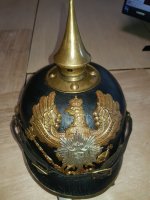
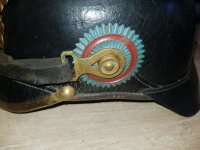
I have already had several occasions to say that the Oldenburg was my favorite regiment, because in August 1870, Grand Duke "Peter II" requisitioned the village where I live, for himself and for the 0JR 91. I particularly like it! (bataille de Gravelotte-Saint-Privat).
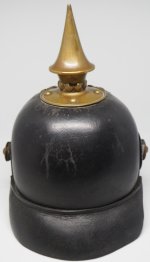
And here is a beautiful M67 clearly marked 0JR 91.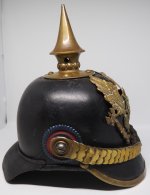
I have already had several occasions to say that the Oldenburg was my favorite regiment, because in August 1870, Grand Duke "Peter II" requisitioned the village where I live, for himself and for the 0JR 91. I particularly like it! (bataille de Gravelotte-Saint-Privat).
And here is a beautiful M67 clearly marked 0JR 91.
Last edited:
Zebedeus
Well-known member
Wow what a platoon! The Odenburg army invaded us.Thanks for sharing! I love it!
I have already had several occasions to say that the Oldenburg was my favorite regiment, because in August 1870, Grand Duke "Peter II" requisitioned the village where I live, for himself and for the 0JR 91. I particularly like it! (bataille de Gravelotte-Saint-Privat).
View attachment 72634
And here is a beautiful M67 clearly marked 0JR 91.View attachment 72635
View attachment 72636

Sandmann
Well-known member
Here are some interesting information about Oldenburg Pickelhauben that perhaps not everyone knows:
As is generally known, there were two Oldenburg regiments, Infantry Regiment No. 91 and Dragoon Regiment No. 19. However, helmets with Oldenburg cockades may also be plausible with stamps from IR30, IR85 (until 1897), FAR26 (2nd and 3th „Oldenburg“ batteries - until October 1899) and FAR62 (2nd and 3th „Oldenburg“ batteries - since October 1899). This is because parts of the military recruiting areas for these Prussian regiments belonged to the Grand Duchy of Oldenburg after the Congress of Vienna. And, as is well known, non-Prussian nationals who served in Prussian regiments had to wear the cockades of their home country.
Sources:
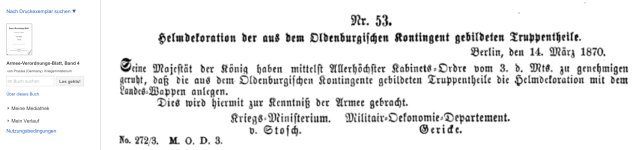
As is generally known, there were two Oldenburg regiments, Infantry Regiment No. 91 and Dragoon Regiment No. 19. However, helmets with Oldenburg cockades may also be plausible with stamps from IR30, IR85 (until 1897), FAR26 (2nd and 3th „Oldenburg“ batteries - until October 1899) and FAR62 (2nd and 3th „Oldenburg“ batteries - since October 1899). This is because parts of the military recruiting areas for these Prussian regiments belonged to the Grand Duchy of Oldenburg after the Congress of Vienna. And, as is well known, non-Prussian nationals who served in Prussian regiments had to wear the cockades of their home country.
- In the case of IR85, however, the Oldenburg cockade was only worn until 1897, because here the mentioned recruits were actually citizens of Lubeck, who until then had belonged to the Oldenburg military recruiting area after the Congress of Vienna. But from 1897 onwards the citizens of Lubeck were recruited into the newly formed IR162 and wore the Lubeck cockade from then on.
- In the case of the FAR26 and FAR62 it is also a bit tricky, because there was a reorganization in 1899 and the FAR No. 62 was founded. Due to this, the 2nd and 3rd "Oldenburg" batteries were transferred from FAR No. 26 to FAR No. 62, which is why the Oldenburg star and the Oldenburg cockades were only worn on the helmets of FAR No. 62 since Autumn 1899.
Sources:
- Bekleidungsordnung: Th. Vorschriften für die Bekleidungswirthschaft der Truppen im Frieden und im Kriege (1888), page 111
- Armee-Verordnungsblatt, Band 31, page 80
- Königl. Preußisch. Ostfriesisch. Feldartillerie-Regiment Nr. 62, page 13
- Bekleidungsordnung 2. Teil (1903), pages 402/403
Last edited:

Oldenburg
Well-known member
Hello Sandy,
Not the IR 30 (Graf Werder), but the 8th Rhenish IR 70, Saarbrücken (1914). Here, the Oldenburg natives were drafted from the enclave of “Birkenfeld” in accordance with the convention of October 1867. Until 1897, the troops wore their Oldenburg and Prussian cockades on their headgear. With A.K.O. of June 16, 1913, Grand Duke Friedrich August of Oldenburg was appointed “chief” of the IR 70.
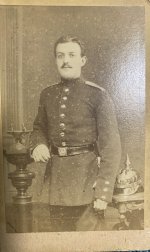
As an example, here is a photo of a musketeer from IR 70. He wears the Oldenburg state cockade on the left side of his M/71 as an Oldenburg (Birkenfeld) soldier!
Best regards
Frank
Not the IR 30 (Graf Werder), but the 8th Rhenish IR 70, Saarbrücken (1914). Here, the Oldenburg natives were drafted from the enclave of “Birkenfeld” in accordance with the convention of October 1867. Until 1897, the troops wore their Oldenburg and Prussian cockades on their headgear. With A.K.O. of June 16, 1913, Grand Duke Friedrich August of Oldenburg was appointed “chief” of the IR 70.
As an example, here is a photo of a musketeer from IR 70. He wears the Oldenburg state cockade on the left side of his M/71 as an Oldenburg (Birkenfeld) soldier!
Best regards
Frank
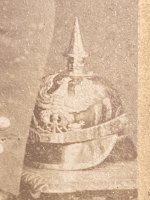
Sandmann
Well-known member
Thank you Frank, this is a beautiful photo 
But I’m confused, because acc. to my knowledge „Birkenfeld“ was related to IR30 and not IR70? Here is a link to the „Militär-Gesetzblatt“ from 1877:
Or has this also changed over the years? However, according to all the books I know the IR30 is always mentioned in connection with the “Birkenfeld” military district, but never the IR70.
But I’m confused, because acc. to my knowledge „Birkenfeld“ was related to IR30 and not IR70? Here is a link to the „Militär-Gesetzblatt“ from 1877:
Or has this also changed over the years? However, according to all the books I know the IR30 is always mentioned in connection with the “Birkenfeld” military district, but never the IR70.

 I am very lucky to have 3 Oldenburgers in my collection including my avatar helmet DR 19. , a M95 and M15.
Oldenburg
Well-known member
Hello Sandy,
An exciting topic. But yes, based on the documents you have provided (1877, Military Code), it is obvious. The Birkenfelders were certainly also recruited for the IR 70. This is clear from the wording of the AKO of June 16, 1913, on the appointment of the Grand Duke of Oldenburg as commander-in-chief: “... The regiment, proven in war and peace, in whose ranks one of Your Royal Highness's countrymen fulfills his military service every year, ...” .
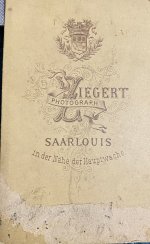
Until October 1912, IR 30 and IR 70 had identical cuffs and blue epaulettes with red numbers. Saarlouis was also the same garrison for a while. Thus, the portrait above could also be of a Birkenfelder from IR 30. So, as I said, it is very interesting that the source from 1877 only mentions IR 30. We would have to take another look at that....
Best regards
Frank
Translated with DeepL.com (free version)
An exciting topic. But yes, based on the documents you have provided (1877, Military Code), it is obvious. The Birkenfelders were certainly also recruited for the IR 70. This is clear from the wording of the AKO of June 16, 1913, on the appointment of the Grand Duke of Oldenburg as commander-in-chief: “... The regiment, proven in war and peace, in whose ranks one of Your Royal Highness's countrymen fulfills his military service every year, ...” .
Until October 1912, IR 30 and IR 70 had identical cuffs and blue epaulettes with red numbers. Saarlouis was also the same garrison for a while. Thus, the portrait above could also be of a Birkenfelder from IR 30. So, as I said, it is very interesting that the source from 1877 only mentions IR 30. We would have to take another look at that....
Best regards
Frank
Translated with DeepL.com (free version)

southsando
Well-known member
There are certainly sone excellent helmets on this thread! I am after my first one at the moment.
CLOVIS 57
Well-known member
It is unfortunate that there is no date on this photo, because:Here are IR 70
---The IR 70 was stationed in Sarrelouis from 1862 to 1876, during the Battle of Sadowa and then during the Franco-Prussian War of 1870.
-- -The IR30 took over this barracks in Sarrelouis from 1876 until the armistice of 1918. (Note that there was a fourth battalion between 1894 and 1896). So the IR 30 was not in Sarrelouis in 1870; at that time, the garrison was in Mainz, then Diedenhofen (Thionville) in 1871.
It's a shame we can't see the back of the helmet. If it has a rear spine, it's one or the other, but if there is no rear spine, it's an IR70. !
Translated with DeepL.com (free version)