First Pickelhaube

Gavin

New member
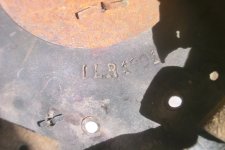
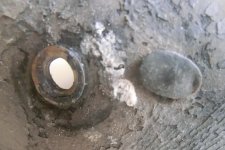
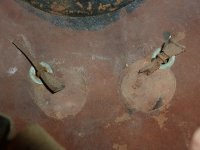
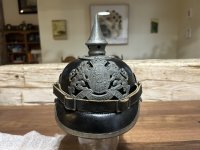
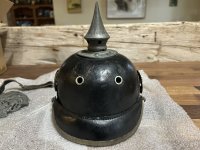
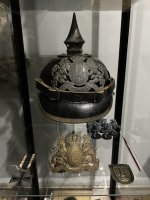
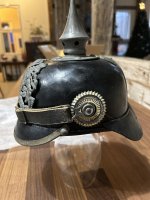
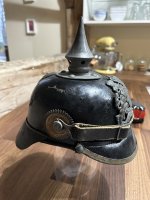
Finally bought my first pickelhaube. I’ve been wanting one for a long time and been doing lots of looking around, I managed to get a good deal on this helmet and bought it. It’s now on display with my small German collection. I noticed there seems to be extra set of holes, what kind of wappen do you think would have been on here originally? They seem to be about 2 1/4” apart for the main ones and the old holes are 2 15/16” apart, I measured from the edge of each hole. I was also wondering how I care for it to make sure it stays in good condition?IMG_2136.jpegIMG_2133.jpegIMG_2135.jpegIMG_2140.jpeg
IMG_2136.jpeg
 
Hello,
There's nothing to be done, it's fine as it is. Just don't expose it to heat, behind a sunny window, above a radiator, etc.
The front holes are positioned for a Prussian eagle, and possibly for a Badish griffin.
The chinstrap appears to be a reproduction.
We would need a photo of the cockades and the back of the chin strap slider (where the stitching is).
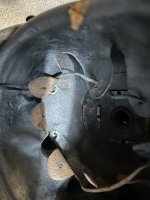
Can you see any markings on the shell or under the neck cover?
 
The chinstrap is a reproduction but the rest of the helmet is original as far as I know. The shell is blacked out.
 

Attachments

  • IMG_2139.jpeg
    IMG_2139.jpeg
    1.6 MB · Views: 18
  • IMG_2138.jpeg
    IMG_2138.jpeg
    1.6 MB · Views: 17
Congratulations on the purchase of your first pickelhaube. 👍 I would agree that the original plugged holes in the shell were for a Prussian eagle. I would also add that in my opinion, the helmet was originally a Prussian M95 with brass fittings. There were 3 reasons for these conversions : a brass shortage, the shine of this brass and finally these spike tops could not be removed in the trenches like the M15. Consequently everything “brass” was removed from your helmet, the original holes were filled in, new steel grommets installed and a Bavarian wappen put on.
 
Congratulations on the purchase of your first pickelhaube. 👍 I would agree that the original plugged holes in the shell were for a Prussian eagle. I would also add that in my opinion, the helmet was originally a Prussian M95 with brass fittings. There were 3 reasons for these conversions : a brass shortage, the shine of this brass and finally these spike tops could not be removed in the trenches like the M15. Consequently everything “brass” was removed from your helmet, the original holes were filled in, new steel grommets installed and a Bavarian wappen put on.
So it was a M95 Prussian helmet but then converted during WWI to a Bavarian?
 
So it was a M95 Prussian helmet but then converted during WWI to a Bavarian?
Yes,
indeed, the M15 steel-grey helmets had poor-quality linings, often made of beige sheepskin or goatskin. The pre-war M95 helmets had very high-quality box calf leather linings treated with black varnish. That is the case here, so I can confirm what b.Loree said.
Regarding the repair and recycling of spiked helmets in the early years of the war (by the B.A., BJA, RBA, and other small requisitioned establishments), yes, many helmets were transferred from one ‘Land’ to another, and yes, old helmets (Bavarian M86s, for example) were taken back and modified to M95s.
0M95-M15  Feldbrauchbar.jpg
And many M95/M15 conversions were probably carried out in ‘field workshops’, directly behind the front lines, when all that was needed was to replace the fittings. The others returned to Germany by train.
;)
 
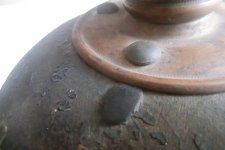
I would also like to add, that this conversion was done with care...... the old holes were filled once the brass grommets were removed. Then the new holes were steel grommeted to match the M15 wappen. This is unusual in my experience as most times the new holes were just punched in without grommets. In addition, in many cases the old original holes are left empty because they were hidden by the M15 wappen. Perhaps in this example, they had to be filled because the replacement wappen was Bavarian?? Anyway, for new collectors.....after you know about "the helmet conversions" you can spot them and realize what was done to an original M95. :) 👍 That is a fantastic foto by the way!!
 
Lorsque le recyclage était officiel et effectué par un BA, il était toujours de bonne qualité, surtout avant la guerre. Des bouchons de cuir étaient placés dans les trous obsolètes, une fine pièce de peau de mouton recouvrait l'intérieur et de nouveaux trous étaient percés avec de nouveaux œillets. C'est le cas de beaucoup de mes Hessois. Les Bavarois avaient tendance à utiliser des disques métalliques semblables aux « fermoirs parisiens ».

In these cases:
---The hull was downgraded to Class 2 or 3 and, above all, was marked with an “F” for Feldbrauchbar, meaning “usable at the front,” but prohibited from use in parades.
Bay1IR Ciney avant Bibi.JPGBay1IR Ciney Bibi marquage.JPG


Bay 1IR Ciney Bibi_.JPG

attache.jpg


Infra, an M95 Hessian, converted to a Prussian M15 by BJA XVIII; The hull has been neatly repainted. (BJA XVIII) Helm 116R M95 become FR80 M15.
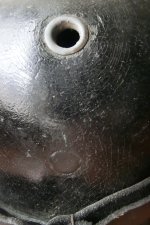
LIR 118 Bibi a Eric.JPG
As above, this old Bavarian M96 infantry helmet was recycled into a Württemberg infantry helmet. Plugs, varnishing of the helmet, fine sheepskin patch on the inside, re-drilling for the new plate, fitting of eyelets. Work virtually invisible. (KB JR become JR124 by BA XIII)
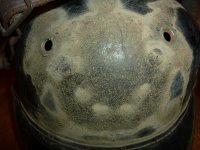
Würt M15 ex Bay M95.jpg

Würt M15 ex Bay. M95.jpg

***On the other hand, the infra helmet was “cobbled together” in the field by a Landser who adapted a helmet found on the ground to his “nationality” by perforating the shell and applying his Land's plaque to it.(here is a Prussian Eagle) Or this was done as an emergency measure by a field workshop behind the lines. This photo is exceptional, taken by the British after the victory at the Somme. It is a trophy, and we are fortunate to be able to see this detail, invisible under the helmet cover of a German soldier.
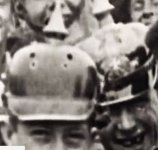
Double perçage (anglais-Somme) -.JPG
 
Last edited:
Excellent photos which really show what we have been talking about....conversion and repair. 👍
 
Back
Top