Well, I have a paid subscription to ChatGPT and this was what it could help with.
My assessment
After examining the photograph closely,
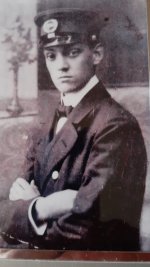
I do not believe this gentleman is wearing an Imperial German Army or Imperial Navy uniform. The photograph may date from the Imperial or First World War period, but the clothing appears to be
civilian occupational dress or company livery.
He is wearing:
- A civilian-cut, single-breasted jacket with notched lapels.
- A waistcoat, white shirt, and small bow tie.
- White gloves.
- A high, stiff service-style peaked cap.
- No standing military collar, shoulder straps, rank lace, military belt, unit numbers, or other normal German military distinctions.
The online copy is only approximately 150 pixels wide, so the internal details of the badge have been lost. Enlarging it makes the shapes larger but cannot recover spokes, lettering, wings, or monograms that are no longer present in the scan.
The cap badge
The badge appears to consist of:
- A relatively large, light-colored oval or circular upper device with a darker center.
- A smaller light-colored device immediately below it.
- A black or dark chinstrap across the cap.
Most plausible identification: railway or municipal transport
My leading possibility is an
Imperial-era railway, tramway, or related transportation employee. More specifically, the upper device could be a badly blurred
winged railway wheel — Flügelrad — with a state cockade beneath it.
The winged wheel became an official Prussian railway symbol in 1853 and was subsequently used on railway uniforms and caps. Before the creation of the unified Reichsbahn in 1920, German railway uniforms were administered by the individual state railway systems and varied considerably. Consequently, there was no single universal “Imperial German railway uniform.”
On a photograph this small, the horizontal wings could have merged into the pale oval shape while the wheel became the darker central mark. The smaller device underneath could be a state cockade. That arrangement is consistent with period railway headgear, although
the photograph is not clear enough to confirm it conclusively.
White gloves would also make sense for a public-facing employee such as a:
- Station employee or railway official.
- Conductor or ticket inspector.
- Municipal tram or streetcar employee.
- Porter, messenger, or ceremonial attendant.
The gloves are supportive evidence, but not proof; photographers also kept gloves and other props in their studios.
Other possibilities
| Possibility | Assessment |
|---|
| Railway or municipal transit employee | Strongest candidate; badge may be a winged wheel and cockade |
| Private commercial service | Also plausible: hotel employee, ship steward, chauffeur, porter, messenger, or company attendant |
| School or student organization | Possible, particularly because he wears an ordinary suit with a distinctive cap |
| Imperial postal employee | Less likely; known Reichspost uniforms were more military in cut |
| Imperial German Army or Navy | Very unlikely |
School or student cap
A
Schülermütze remains a reasonable secondary possibility. German Gymnasium, Realgymnasium, and Realschule pupils commonly wore distinctive school caps from the 1870s through the early 1930s. These caps were worn with ordinary civilian clothing—not with school uniforms—and differed by school, class level, and locality.
The young man’s suit and bow tie fit that tradition. Nevertheless, his cap is unusually high and service-like, and its large front badge looks more occupational than most surviving school caps. The white gloves also favor a formal service or employment role.
Private company or maritime service
Another credible possibility is a
private-company cap, perhaps connected with a hotel, transportation company, steamship line, or chauffeur service. Ship stewards and other commercial employees could wear civilian-cut dark jackets, ties, white gloves, and caps carrying the employer’s badge rather than national insignia. German shipping companies such as Norddeutscher Lloyd issued their own cap insignia and uniforms.
I cannot match the blurred device specifically to Norddeutscher Lloyd, HAPAG, or another company, however.
Why it is probably not military
Imperial German Army peaked caps after 1897 normally displayed
two comparatively small round cockades: the Reich cockade and the appropriate state cockade. They accompanied a recognizable military Waffenrock or field tunic with a standing collar, shoulder straps, military buttons, and other distinctions. That combination is absent here.
The Imperial Navy is an even poorer match. Its officer and official caps generally carried conspicuous naval devices involving a crown, cockade, wreath, or anchor and were worn with distinctly naval uniforms—not an ordinary three-piece lounge suit.
Imperial Reichspost uniforms were generally dark blue garments based on the military Waffenrock pattern, with a standing collar and Imperial eagle buttons. Surviving postal caps show an eagle above a state cockade. The gentleman’s lapelled jacket and indistinct oval badge do not correspond closely.
Best working identification
An Imperial-era German civilian transportation or service employee—most likely railway or municipal transit—with a probable occupational badge, possibly a winged railway wheel above a Prussian state cockade.
I would catalog it provisionally as:
Young German railway, tramway, or private-service employee, circa 1900–1920; peaked occupational cap with unidentified company or railway badge. Not an identifiable Imperial German military uniform.
The strongest evidence would come from the original photographic card: a photographer’s imprint, town name, handwritten occupation, or a genuinely higher-resolution scan of the cap. Any attempt to “restore” the existing badge far enough to reveal letters or precise symbols would risk inventing details rather than recovering them.