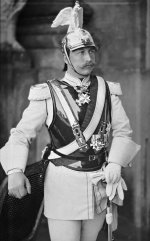
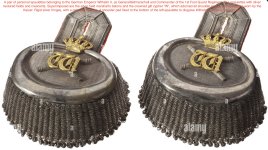
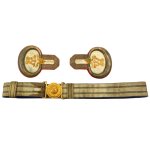
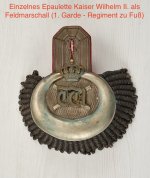
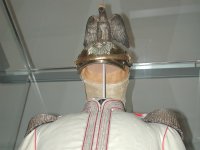
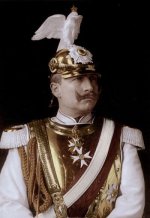
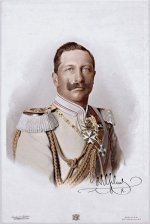
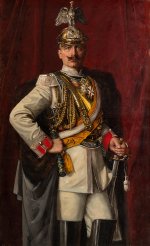
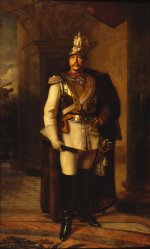
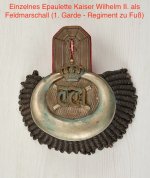
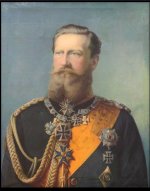
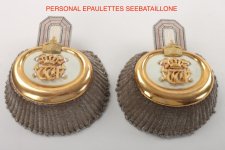
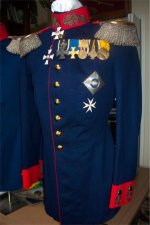
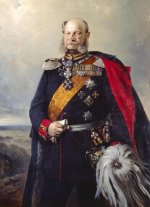
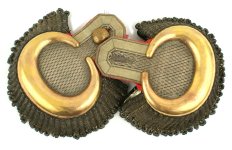
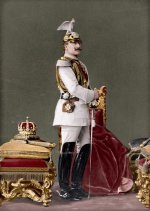
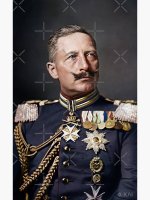
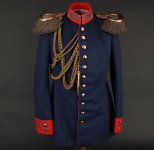
You wanted to re-construct the personal GdC epaulets of Emperor Wilhelm II. That’s why I added the link from the forum warrelics, which shows pretty clear that he wore epaulets with a golden half moon, silver braids and just one golden star in the center of the field (no batons). The underlay was red. You can see that it his personal GdC uniform, because of the medals. Of course he had more GdC uniforms then one, so the other add on to the field are plausible as well. As far as I know there was no special rule how the epaulets design of the King should look like. Normally it should be in acc. to the clothing regulations, but I think nobody would have criticized the Emperor for a different design.
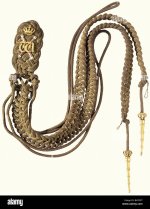
The cords worn on the uniforms of Emperor Wilhelm II and the officers in the army were primarily insignia of special functions, positions or personal honors. They served a representative purpose, indicating high rank or membership of the personal staff (à la suite), particularly in the case of officers and adjutants. Golden cords emphasized the status of the wearer. If he wasn't wearing any cords, it was probably because these were early photographs, taken before he became King or shortly after he became King.
This is what I have about the different cuirass colors:
- Enlisted men cuirass M1845 (for line cuirassier regiments). For enlisted men and non-commissioned officers of regiments 1-8, without non-commissioned officers of regiments 2 and 6: Steel plate with brass fittings, central shot test, straps with 16 scales on hinges and belly strap for closure.
- Officer cuirass from about 1900 for line cuirassier regiments. For officers of the regiments 3-5, 7 and 8: Nickel-plated thin steel plate, edges also nickel-plated, gold-plated long scale chains on lion's head hinges, clasps decorated with oak leaves, quilted silk lining with cuffs.
- Enlisted men’s cuirass M1845 for guard regiments. For enlisted men and non-commissioned officers: Based on French models or French trophies, heavy cast steel covered with brass, brass ring chains on the shoulder straps, linen lining with cuffs.
- Parade cuirass for enlisted men of the Gardes du Corps. Black lacquered sheet iron with red wool cord attached to the outside, brass fittings, linen lining with cuffs, appliqué trophy of the M1912 ring collar. Originally, black parade cuirasses were presented to the GdC as a gift from the Russian Tsar in 1814. These were replaced in 1897 by Kaiser Wilhelm II with the more elegant design shown here on the occasion of the 100th birthday of his grandfather Wilhelm I.
- Sergeant's cuirass for guards and KR6 around 1870 (officer's uniform). Cuirass for non-commissioned officers, steel plate covered with brass sheet metal, nickel-plated edging, leather shoulder straps trimmed with brass scales, linen lining without cuffs. Differs from the officer's version in that it has no oak leaves on the clasps and no lion's head hinges.
- Officer's cuirass circa 1870 for line regiments. For officers of regiments 3, 4, 5, 7, and 8, nickel-plated thin steel plate, edges also nickel-plated, gold-plated rivets, gold-plated long scale chains on lion's head hinges, clasps decorated with oak leaves, quilted silk lining with cuffs.
- Enlisted men's cuirass M1845 for the Life Cuirassier Regiment. Steel plate with brass fittings, central shot test, straps with 16 scales on hinges and belly strap for closure.
- Officer's cuirass M1844 for the Life Cuirassier Regiment. Nickel-plated thin steel sheet, edges gold-plated, gold-plated long scale chains on lion's head hinges, clasps decorated with oak leaves, applied officer's trophy of the M1896 ring collar, quilted silk lining with cuffs; from 1844 onwards, the LKR was the only regiment to have gold-plated edging, initially with silver-plated and later with gold-plated rivets.
(Source:
www.kuerassierregimenter.de/ausruestung.php?det=&did=52)