TWO NEW VICTORIAN BRITISH INFANTRY OFFICER'S HOME SERVICE HELMETS IN MY COLLECTION

Yeohelmetguy

Well-known member
Hello all,

These two Victorian era British Army home service helmets arrived this past week. Both are volunteer officer's home service helmets, hence their all-silver fittings and front helmet plates. The first home service helmet is an extremely rare helmet to a volunteer officer of the 2nd Midlothian and Peebles Rifle Volunteers. This regiment became the 4th Volunteer Battalion, The Royal Scots (Regiment). The helmet was worn from 1881 through 1888.

The second home service helmet is to a volunteer officer of the 1st Volunteer Battalion, The Royal Lancaster Regiment, again identified as a volunteer by the all-silver fittings and helmet plate and the secondary scroll under the regimental title scroll inscribed "1st Volunteer Battalion". This helmet was worn from 1881 through 1901. I have included a helmet plate, also from my collection, worn by the two regular battalions of The Royal Lancaster Regiment. Note that the regular battalion's helmet plate is in gilt.

Kind regards all,

David

2nd MIDLOTHIA AND PEEBLES RIFLE VOLUNTEERS:
View attachment 38493

View attachment 38494

View attachment 38495

View attachment 38496

View attachment 38497

HOME SERVICE HELMET 1st VOLUNTEER BATTALION, THE ROYAL LANCASTER REGIMENT BELOW:
View attachment 38498

View attachment 38499

View attachment 38500

View attachment 38501

View attachment 38502
 
Last edited:
Congratulations on the new additions (y)
Its always exciting to add something new especially when they are in such nice condition.
 
Wow David - those are beautiful and worthy additions to your already impressive collection!
 
Hi John!

Thank you!!! It's like an early Christmas at my home with the arrival of these two new helmets. I agree with you, it is exciting to acquire new pieces for the collection and made even better when those pieces are of exceptional quality and exceed expectations! Thank you taking time to look at this post (and my previous posts) and your always very kind, very generous and very motivating remarks!!

Best regards,

David

Thanks David,

Its always a pleasure to follow your posts and see whats new. They are always excellent, being well presented with detailed photo's and information. I always learn something (y) Happy hunting John Josef
 
Hello David,
I have now found the article on your latest additions to your collection! What magnificent helmets! I always admire the strong individual expressiveness of the helmet emblems (Zirate) in the British Army! (y) :)
Frank🇩🇪
 
The officers 2nd Midlothian & Peebles RV's helmet is an outstanding example and is extremely rare.

The battalion was consolidated in 1880 (from a number of smaller units which dated from 1860 / 1861) with its headquarters in Penicuik and eleven companies spread over the Midlothian and Peebles areas. The initial headdress was a glengarry with a red, white and blue diced border until circa 1886 when the home service pattern helmet was introduced.

In April 1888 the battalion became the 6th (rather than the 4th) Volunteer Battalion of the Royal Scots - accordingly your helmet was possibly only used for about two years. I have an OR's helmet to this unit which had holes formed at the top and bottom of the central circle on the helmet plate to allow a 6th VB Royal Scots badge to be added thus saving the expense of issuing new plates to the OR's!
 
Hi David,

I saw your 4th VB helmet on your other thread - its another fine item and very rare.

You summarise the battalions history there but you might be interested to know that the 3rd City of Edinburgh Rifle Volunteer Corps were initially raised in 1867 as a corp of total abstainers. Presumably this must have differentiated them from the 1st & 2nd Corps!
 
The condition of the helmets is first class, I think I like the silvered fittings better than the brass fittings, Congratulations. Rob
 
The Royal Scots are my local infantry unit which recruited (mainly) from Edinburgh and the Lothians. The history of the regular battalions is well known, from their formation in 1633 by Sir John Hepburn under a Royal Warrant granted by King Charles I through to the formation of the Royal Regiment of Scotland in 2006. They were the oldest Infantry Regiment of the Line in the British Army.

The history and heritage of the Volunteer units raised following the great invasion scare of 1859 and their route to becoming battalions within the Royal Scots is a fascinating story. This is perhaps less well known than the history of the regular unit even although, where I live, the echoes of the Volunteer units remain from their grand Victorian or Edwardian drill halls (some still in use as Army Reserve centres) to local public houses still called 'The Volunteer Arms' where in the past the troops would pause for 'refreshment' after training.

… hello… I am absolutely thrilled to have those two exceptionally rare and I would judge exceptional quality examples of officer’s home service helmets associated with such a distinguished Scottish regiment as was/is The Royal Scots as part of my collection! If my feeble memory serves me correctly, if I recall the 3rd Volunteer Battalion was consolidated/renumbered the 2nd Volunteer Battalion somewhere about 1880 and then circa 1888 becoming the 4th Volunteer Battalion, Royal Scots and remained as such until transfer to the Territorial Force as the 6th Battalion (TF). I also have in my collection a lovely two-piece officer’s home service helmet plate to the 2nd Edinburgh (City) Rifle Volunteer Corps.

You detailed the journey of the 3rd City of Edinburgh RVC to becoming the 4th Volunteer Battalion Royal Scots in your 4th Bn thread. The 2nd Edinburgh Rifle Volunteers were formed in 1880 but it was a further two years before they were constituted as an independent unit having until then been 'attached' to the Queens City of Edinburgh Rifle Volunteer Brigade (which comprised the much larger 1st & 2nd City of Edinburgh RV's). The helmet to which your plate would have been attached was also adopted in 1882 to replace the shakos the unit previously wore.

As am aside, I was a United States Army officer stationed in then West Germany and had the opportunity to do some work in association with the 1st Battalion, The Royal Scots when they were posted in Werl, West Germany in 1985.

I didn't serve in the Royal Scots instead I joined the Royal Artillery in 1985 - bigger 'toys'!

Interesting tidbit about the 3rd Volunteer Battalion... it seems though that the drinkers, at least re-numbering wise, won out over the abstainers!!! LOL, LOL, LOL!!!!

The 3rd City of Edinburgh RVC was drawn from no.16 company of the 1st City of Edinburgh RVC and initially mustered 2 companies in 1867 although that had risen to 6 companies by 1877. To put this in perspective, the 1st (who presumably were the drinkers who frequented the 'Volunteer Arms' pubs) totalled 27 companies by the formation of the 1st, 2nd & 3rd Volunteer Battalions Royal Scots. So yes, I think you may be right that the drinkers outnumbered the abstainers!
 
Thanks David - your Aberdeen Artillery officers helmet is another fine piece!

The 1st Administrative Brigade Aberdeen Artillery Volunteers was initially formed in October 1860 to pull together circa 6 batteries which had formed a few months earlier throughout Aberdeen and the surrounding towns. There followed a number of reorganisations - too many to list here - with batteries being formed, disbanded or transferred to another brigade but by 1880 / 1882 (likely to be the approximate date of your helmet) the now formed 1st Aberdeenshire Artillery Volunteers comprised 10 batteries of which 7 were within Aberdeen. Aberdeen was not a huge city at this time although it was an important port - it must have bristled with firepower!

The locations of the batteries early drill halls aren't known to me but the corps headquarters was built in 1899 in North Silver Street, Aberdeen at a cost in excess of £7,000. I'm not sure if this remains but there is a likely looking building at the junction of North Silver Street and Skene Terrace. Unfortunately Aberdeen is largely built in granite, a very hard light grey stone, which is dificult to carve thus it's unlikely the building would have had its unit title in stone above the door.

As an aside, you're probably aware, but the difference between your regular officers helmet plate and that of the volunteer officer (aside from one being gilt and the other silver with the lower moto replaced) is that the regular officer has the Royal Artillery battle honour 'Ubique' meaning 'Everywhere' above the gun whereas the volunteer officer has what is supposed to be a spray of laurel leaves.

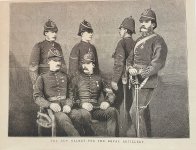
For interest, I attach an illustration published in the 'Graphic' paper dated 12 January 1878 showing their readers the proposed new helmet for the Royal Artillery. How long the RA wore the spike for is uncertain but a number of sources I have seen consider it was worn from the helmets introduction in 1878 to circa 1881.

IMG_1092.JPG
 
Last edited:
Back
Top