Bavarian pickelhaube just purchased help with markings

Chris,
Pickelhauben have been worn a very long time, often till the end of 1916, and sometimes longer in some units.
The M16 was first introduced february 1916, with only very little number, only for the guys who were immediatly in the first lines. It is written in a few Regiments-Geschichte that I have read. The general introduction of the M16 in big numbers started only during the summer 1916.
Philippe
 
Hi Philippe, that is very interesting, it must have been scary only having a leather helmet for shrapnel protection.

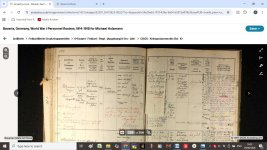
I fed the kriegsstammrolle into A1 for a translation and was staggered how well it produced a summary column by column. I expect you can read the old writing but having it translated was amazing for me. He received two medals for bravery and was hospitalised with shell splinters 8 May 1917.

One of the medals was awarded 29 September 1918 so he returned to the war. AI suggested that there might be a second page to the Kriegsstammrolle which documents his hospitalisation and returning to the war. When you kindly got the Kriegsstammrolle details for me did you happen to see if there was a second page for him.

John Josef warn me research etc was addictive-he was right!😊
Many thanks for you continued help (and patience)
Chris
 
Welcome to the world of pickelhaube Chris! We need to warn you though.....you can begin with one helmet and years later you may have 100+. Haubeitis is rampant here so beware! :)
Yes Chris
Welcome to the forum, and yes Brian, is correct about collecting pickelhauben can get to be a habit. You have a great start with this one. The reinforcement to the inside is cool and not always in all helmets with the cross form on the inside. Unit marked, named and traceable are also great extra’s that one does not often found.
Best regards
John
 
Chris,
Pickelhauben have been worn a very long time, often till the end of 1916, and sometimes longer in some units.
The M16 was first introduced february 1916, with only very little number, only for the guys who were immediatly in the first lines. It is written in a few Regiments-Geschichte that I have read. The general introduction of the M16 in big numbers started only during the summer 1916.
Philippe

That's correct. The front line troops at the start of the battle of Verdun were the first to receive a Stahlhelm. In the beginning these stayed there. So when units were relieved or rotated, the newly arrived soldiers took over the M16 helmet.
German regiments usually stayed way longer in the same sector than the French. Often only when they moved away to a sector with heavier fighting, their Pickelhaube got replaced by a Stahlhelm.

The famous Bavarian RIR 16 for example fought at the Fromelles sector for more than one and a half year. At the end of september 1916 they were sent to the Somme and it is them that they received their new M16 Stahlhelm.

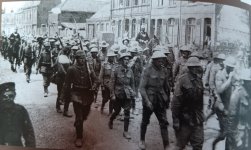
Here you can see Australian and British troops, captured after the desastrous attack at Fromelles on July 19th, 1916. Both the german Infanteristen and the mounted troops can be seen still wearing the iconic Pickelhaube.

20260605_102408.jpg
 
That is astounding that they continue so long with just a leather cap. But having looked it up the British tin helmet was issued in Sept 1915 but only 50 per Battalion. Mass issue did not occur until summer 1916, so we were no better. It sort of reflects perhaps the attitude of Administrators/war chiefs to the ordinary soldier- they were just numbers! Or am I being too harsh and it was just a case of the shortage of material?
That is a very interesting photo thank you Grabenmaxx
Chris
 
Philippe very kindly provided a copy of Ancestry showing Michael Holzmann's war service etc. So I thought I would subscribe to Ancestry to get details of his post war wound (8 May 1917) service and his subsequent life. I got AI to translate both documents. However I found this record (13825) for a Michael Holzmann which has the same birthday and parents (but wife's born name is Fischl instead of Fickl) and his birth place is shown as Jetzendorf and not Immenhafen per the copy Philippe made. The war service is different but the medals are the same and the fact he was a Kanonier is the same in both.
What is going on!! Is AI making up what it can't read? I am not very good with Ancestry so any advice would be very welcome. I am very confused.🤔
Chris
 

Attachments

  • Keiegsstammrolle 13825.jpg
    Keiegsstammrolle 13825.jpg
    184.4 KB · Views: 1
When I ran it with AI the first time I did two photos one of each side on the book . This time I did it with a picture of the two pages and AI came up with Holzmann being a Railway worker from Ausberg! So I think it is AI that is having the problems. Does anyone know a more certain way to get AI to translate the old German script? Frustrating!
Chris
 
Sorry to all that I keep coming back . I have now found that a zoomed in image gets read correctly by AI . It must be if it can't read something it just guesses but doesn't tell you its a guess! I now seem to be getting sensible translations. Please ignore my last few posts made out of frustration!
Chris
 
Two questions for the forum members
First, Can someone confirm or refute that the Pickelhaube was worn back in Garrison or when attending training back in the homeland?
Second the idea of using AI sounds intriguing to me. Is there a specific one that is more accurate in translation?

Thank you in advance.!

Best regards,
John
 
I am getting better success now with translations although still some gremlins- His father is a farmer but one report had him as Master plaster!!
I'm using the google one, Gemini I think.
Steps I'm using are
1 Make a zoomed screen shot of the record, one screen shot for each page and make as zoomed as possible .Save as JPG. I load screen shot into Paint control V and then "Save as"
2 Open up google, select AI mode . At prompt "ask anything" type in "translate the photo from old german to english"
3 Click on the + sign and upload the photo
4 Start the AI analysis, usually an "AI mode>" or "an up arrow" to click
5 Analyst should appear in 30 seconds.
6 If you want a file copy or a print out don't do it from the google screen, it usually mixes up the formatting. Use copy function (Right click mouse) and drop a copy into Word or other word processor.

Sounds longwinded but once you get going!
Have fun
Chris
 
Last edited:
Hi Chris,
I have used Google's AI myself when researching military photos and found it can be wildly inaccurate. I once uploaded a picture of a grave of Armierungs Bataillon 74, added both the unit and the name (that I could read myself on the cross) to the search, and the AI came back and told me it it was a different person in a different unit.
In my opinion AI can be an excellent tool to help with suggestions about what is written in the documents, but it still needs human verification.
Regards,
Lars
 
Try tu use gemini as IA. But this IA even is confusing sometimes...

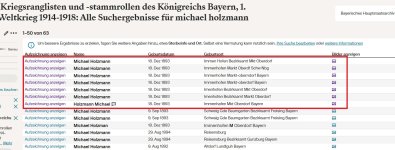
There are all in all 7 double pages for this guy in the Münich Kriegsstammrollen and they are giving all the same informations but completed in time:

holzmann3.jpg

Chris, the bavarian Kriegsstammrollen are not always perfect, as the Verlustlisten. Or the people who digitalized the archives made some transcription errors, specially in the names orthograph and sometimes in the birth dates.. Nobody is perfect especially with this old german writing style..

Immenhofen (near Markt Oberdorf) is the only given place of birth and living. Jetzendorf obviously is a IA delirium...

M. Holzmann was Bauersohn and Bauer (farmer, as his father was). His mothers birthname is Fichtl and not Fickl.

On the 21.7.18, because of a foot compression (right foot), he was transfered ton the Kriegs Lazarett Longuyon, then on the 12.8.18 to the Reserve Lazarett Pforzheim and on the 6.9.18 to the Ersatz-Abteilung of the KB FAR 4 in Germany. It seems he never went back to the frontline.

Philippe
 
Two questions for the forum members
First, Can someone confirm or refute that the Pickelhaube was worn back in Garrison or when attending training back in the homeland?
Second the idea of using AI sounds intriguing to me. Is there a specific one that is more accurate in translation?

Thank you in advance.!

Best regards,
John
John, yes, the Pickelhaube was worn till the end of war in the Ersatz-Bataillonen where the new recruits were trained or wounded and ill recruits were for recovery before they were sent again to the front.

And something else: the Pickelhaube still was a regular part of the uniform. So each soldier had a Pickelhaube in a depot or barracks located behind the lines during periods of rest. The spiked helmet was then worn there during guard duty, parades or official ceremonies, later essentially M15 Pickelhauben. All those Pickelhauben were kept under strict surveillance by the quartermasters. I read that in a Regimentsgeschichte of a Baden unit.

Philippe
 
Hi Philippe
Thank for digging further into Herr Holzmann records. I have taken a monthly subscription to Ancestry both to try to find his later life (marriage, death if he had a long life ) but also to research my wife's paternal grandfather to see if he had WW1 service.

You are right there are so many records for Herr Holzmann , AI suggested each time he had a major change in circumstances a new record was started and a line drawn through the old.
Two records had his mothers maiden name as Fiesel.
You did well to find it was a foot injury he suffered from.

In light of the foot injury 21 July 1918 I wonder when the battle was that he earned the Bavarian Military Merit Cross awarded 29 Sept 1918 ? I can't find any service record past 31 Oct 1917 translated as "redeployed back to the front lines with active units of the 4 Field Artillery Regiment which appeared in record 13796.

He was awarded the Iron Cross 10 June 1917 which probably followed his wounding 8 May 1917.

Being able to research a soldier in such depth brings personality to his Pickelhaube which ceases to be just an object and becomes a part of someone's life.
Chris
 
Back
Top