Chainstitching, soutache, woolen monograms...?

Bobertil

New member
Hello everyone
This is my first time posting here, and I hope some of you clever heads can help me.

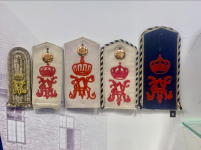
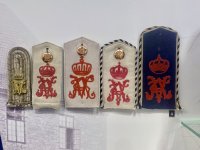
You see, the embroidery methods for M1895 shoulder boards have me quite confused. Shoulder boards for the bunte Rock are a pretty new topic for me, and one that I don't (yet) know much about. My question regards the cyphers and monograms of the boards: I see both hand-embroidery, chain-stitching, soutache and woolen monograms having being used, but is there a general rule of thumb as to what method would have been used when?

I'm particularly curious as to which method would have been used for issue-quality shoulder boards manufactured c. 1910, as I suppose private-purchase uniforms would use whatever method the customer preferred?

Best regards
Bertil
 

Attachments

  • IMG_3132.jpeg
    IMG_3132.jpeg
    1.8 MB · Views: 21
Hello!
Interesting questions!(y)
From my own experience can say :

The embroidery style used was whatever embroiderer in workshop had/
Lower ranks (Mannschaften ( were unlikely to by able to chose their own shoulder straps or commission custom ones /
But off/candidates were quite free to chose custom embroidery /
 
Hi Bertil,
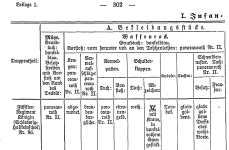
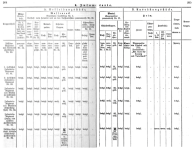
In the 1896 clothing regulations both Nummerschnur / Plattschnur (is that what you call soutache?) and chain stitching were allowed for the numbers on enlisted men's shoulder straps, by 1903 only chain stitching was specified.
For regiments with monograms, crowns, etc. there were more options, and both chain stitching and cloth applications were possible for enlisted men.
Hand embroidered I have only seen on private purchase items, certainly for regiments with just numbers. When chain stitching had become regulation, the Nummerschnur / Plattschnur was sometimes used on private purchase items.
Hope that helps,
Regards,
Lars
 
Hello!
Interesting questions!(y)
From my own experience can say :

The embroidery style used was whatever embroiderer in workshop had/
Lower ranks (Mannschaften ( were unlikely to by able to chose their own shoulder straps or commission custom ones /
But off/candidates were quite free to chose custom embroider
Hi Bertil,
In the 1896 clothing regulations both Nummerschnur / Plattschnur (is that what you call soutache?) and chain stitching were allowed for the numbers on enlisted men's shoulder straps, by 1903 only chain stitching was specified.
For regiments with monograms, crowns, etc. there were more options, and both chain stitching and cloth applications were possible for enlisted men.
Hand embroidered I have only seen on private purchase items, certainly for regiments with just numbers. When chain stitching had become regulation, the Nummerschnur / Plattschnur was sometimes used on private purchase items.
Hope that helps,
Regards,
Lars
Hi Lars

Thanks a lot for your informative answer! I did not know of the correct terms "Plattschnur" and "Nummerschnur", but I'm certainly adding those to my mental dictionary from now on;).
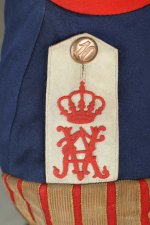
I am particularly interested in what Füsilier-Regiment 86 would have worn, as I have seen both woollen monograms, fine embroidery and chainstitching on issued examples. Attached are some examples of their "AV" monogram as seen in the Sonderburg Castle Museum, and a picture of the woollen monogram of a (possibly private-purchase?) musician's uniform.

Is there any general rule-of-thumb as to when chainstitching was used versus cloth application? Were both things issued in the same time period, so that various enlisted men of the same company could be issued with both types at the same time, for example?

And another thing: Was chainstitching also used for the shoulderboards of the M1894 Feldmantel post-1903? So far I have only seen the woollen monogram type as seen in the picture, but then again, that might just as well be survivorship bias, it being an Einjährigfreiwilliger example.

Any help would be much appreciated.
Best regards
Bertil
 

Attachments

  • Skærmbillede 2026-06-16 185928.png
    Skærmbillede 2026-06-16 185928.png
    3.3 MB · Views: 0
  • stropper hvud.jpg
    stropper hvud.jpg
    97.1 KB · Views: 0
Back
Top